The Best Prompt Engineering Books, Matched to What You Want to Build
Prompt engineering books worth your time in 2026, matched to your role, plus which chapters have aged and the free official guides to read with them.

On this page
- Quick Picks
- The Books
- Prompt Engineering for LLMs
- Prompt Engineering for Generative AI
- AI Engineering
- AI Prompt Engineering Absolute Beginner's Guide
- Books Age Fast: What to Skip in Older Editions
- Free Reading to Pair With a Book
- Frequently Asked Questions
- What is the best book for learning prompt engineering?
- Are there free prompt engineering books or PDFs?
- Do I need a book to learn prompt engineering?
- Which prompt engineering book is best for developers?
- Your Move
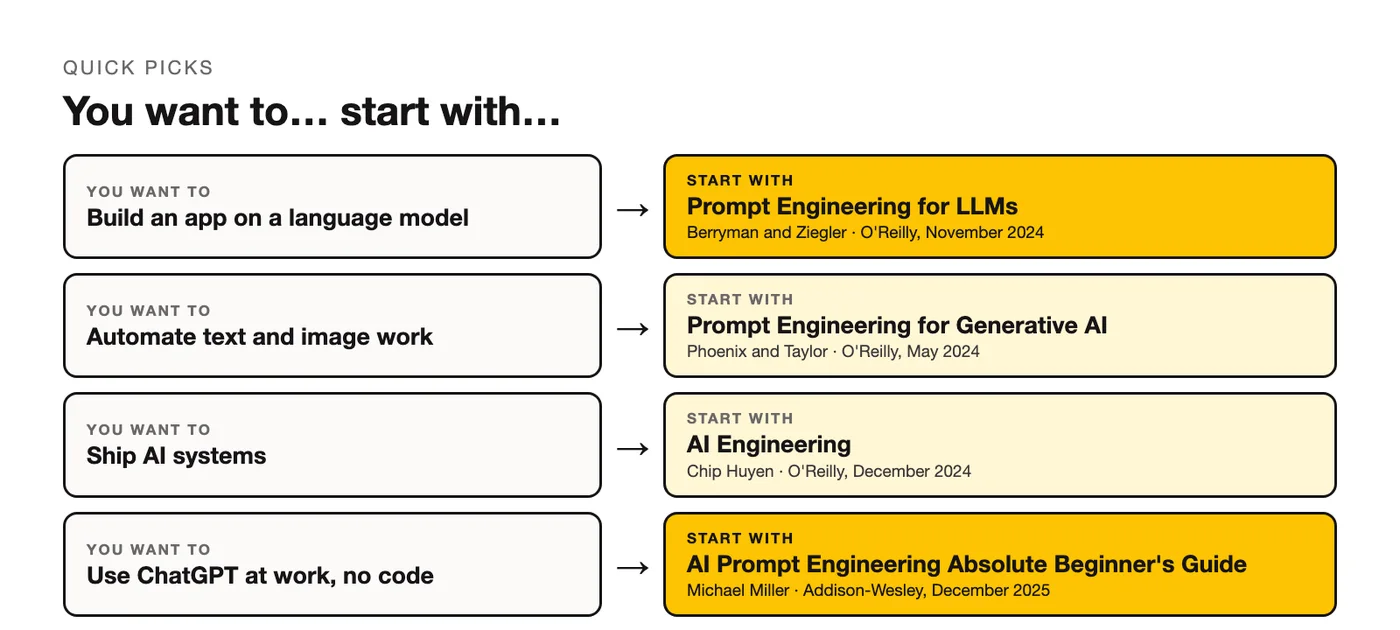
Prompt engineering books are worth buying when they match the work you do, so this list starts with the answer. If you write code and you're building on a language model, start with Prompt Engineering for LLMs. If you use ChatGPT at work and don't code, start with AI Prompt Engineering Absolute Beginner's Guide. The list below holds four books whose author, publisher and date we confirmed on the publisher's own page in November 2026, and each one is described from that page.
Quick Picks
The best prompt engineering books for four kinds of reader:
| You are | Start with | What the publisher says it covers | Publisher, date |
|---|---|---|---|
| A developer building an LLM app | Prompt Engineering for LLMs | A prompt strategy for an application, context, few-shot, chain of thought, RAG | O'Reilly, November 2024 |
| Automating text and image work | Prompt Engineering for Generative AI | Text generation, LangChain, vector databases, agents, image models | O'Reilly, May 2024 |
| An engineer shipping AI systems | AI Engineering | Evaluation, prompt engineering, RAG and agents, fine-tuning | O'Reilly, December 2024 |
| Using ChatGPT at work, no code | AI Prompt Engineering Absolute Beginner's Guide | Anatomy of a prompt, core techniques, prompts by task, templates | Addison-Wesley, December 2025 |
The Books
Prompt Engineering for LLMs
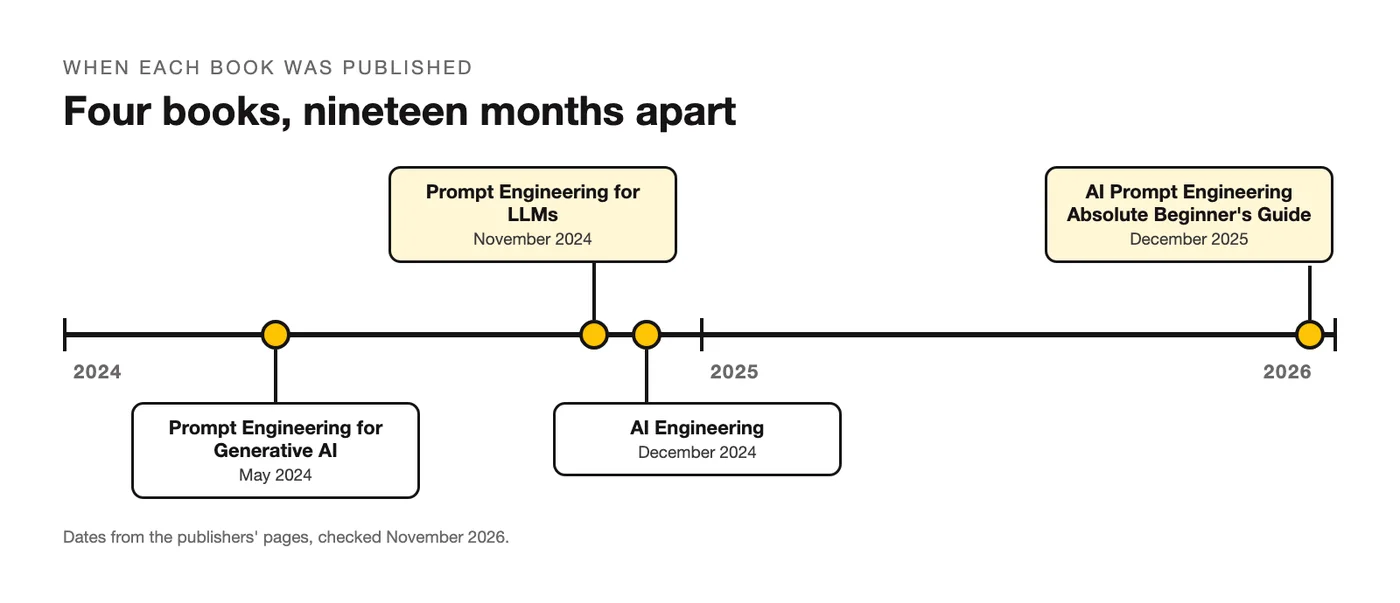
By John Berryman and Albert Ziegler. O'Reilly Media, November 2024. O'Reilly labels it intermediate to advanced.
For: developers building applications on top of language models.
O'Reilly's page says the book teaches you to design a complete prompt-crafting strategy for an application, to gather, triage and present context, and to use techniques including few-shot learning, chain-of-thought prompting and RAG. The first part covers how LLMs work and the move to chat models. The second covers prompt content and assembly.
Check against current docs: the chain-of-thought material, for the reason given in the next section.
Prompt Engineering for Generative AI
By James Phoenix and Mike Taylor. O'Reilly Media, May 2024. O'Reilly labels it beginner to intermediate.
For: people building text and image pipelines.
The contents on O'Reilly's page open with five principles of prompting, then move through text generation with ChatGPT, LangChain, vector databases with FAISS and Pinecone, agents with memory and tools, and image generation with Midjourney and Stable Diffusion.
Check against current docs: the tool chapters. Compare any code with the tool's current documentation before you copy it.
AI Engineering
By Chip Huyen. O'Reilly Media, December 2024. O'Reilly labels it intermediate to advanced.
For: engineers for whom prompts are one part of a system.
The publisher describes it as a book about building applications with foundation models. Prompt engineering is one chapter, next to evaluation, RAG and agents, fine-tuning, dataset engineering and inference optimization. Read it to see where prompting sits in a product, and pair it with one of the two books above if prompts are your daily work.
AI Prompt Engineering Absolute Beginner's Guide
By Michael Miller. Addison-Wesley Professional, published 15 December 2025.
For: office users with no coding background.
Pearson's page says it walks through the anatomy of a prompt (goals, outputs, constraints, tone and style), then zero-shot, one-shot and few-shot prompting, role-based prompting, chain of thought, self-consistency, prompt chaining and multimodal prompts. Later chapters cover prompting for writing, productivity, images, video and music, and an appendix holds prompt templates. It's the newest book on this list.
Books Age Fast: What to Skip in Older Editions
A printed chapter can't follow a model release. Two of the four publisher pages above list chain-of-thought prompting among the techniques taught. OpenAI's reasoning best practices now include the line "Avoid chain-of-thought prompts" for its reasoning models, because those models reason internally. The technique still has uses elsewhere, and our piece on why chain of thought advice has changed covers where.
One rule works for any book: trust the chapters on principles and structure, and check anything tied to a model version, an API or a tool against the vendor's current page.
Free Reading to Pair With a Book
- Anthropic's prompting best practices for current Claude models. We also have Anthropic's prompting guide, summarized.
- OpenAI's reasoning best practices, linked above, for prompting reasoning models.
- Our free prompt engineering guide, with a shorter list of prompt engineering tips for a first pass.
Frequently Asked Questions
What is the best book for learning prompt engineering?
The one written for your starting point. Use the publisher's level label as the first filter: O'Reilly marks its three as beginner to intermediate or intermediate to advanced, and the Addison-Wesley title is a beginner's guide by name. Then look at the contents list and pick the book whose chapters match the next thing you need to build.
Are there free prompt engineering books or PDFs?
The official guides from Anthropic and OpenAI are free to read online, and so is our guide. The four books here are sold by their publishers, and O'Reilly's pages offer its titles through an O'Reilly membership as well. A "free PDF" of a paid book is an unauthorized copy, so we don't link to any.
Do I need a book to learn prompt engineering?
No. Practice and the vendor guides cover a lot of ground. A book earns its price when you want a structured path or you're building something that has to work every time. For a path without a book, see a prompt engineering roadmap, and for the job itself, what a prompt engineer does.
Which prompt engineering book is best for developers?
Two are written for developers building on models: Prompt Engineering for LLMs for the prompts themselves, and AI Engineering for the system around them. If your work includes image models too, Prompt Engineering for Generative AI is the one with Midjourney and Stable Diffusion chapters.
Your Move
Pick the row of the table that describes you, open the publisher's page for that book and read its contents list. If three of the chapters are things you need this quarter, it's your book.
Put this into practice: start with our free prompt engineering guide while the book ships. Want prompts ready to use alongside it? The Complete AI Bundle puts the whole prompt library, Custom GPTs and n8n workflow templates behind one payment, with lifetime access.
Prompts for this topic
Put this article to work with ready-to-use prompts from the God of Prompt library.
Keep reading
Image-to-Video Prompts: How to Turn a Still Photo Into a Video That Moves the Way You Want

Beyond Prompt Engineering: Fixing the Generic Patterns Left in AI Writing
5 Steps to Build Reusable Prompt Templates
Build flexible, consistent prompt templates in five steps: choose variables, set role and context, structure requests, define output format, then test and refine.

The best of the blog, in your inbox
One email when notable prompts, tools, and model updates land. No spam, unsubscribe anytime.
Join 100,000+ subscribers. One email a week, real prompts, tools, and model updates. Unsubscribe anytime.