CRIT AI Prompt: Framework, Template and 6 Examples
What the CRIT AI prompt stands for, a fill-in template, one example worked through the Interview step, and six CRIT prompts you can copy today.

On this page
- What CRIT Stands For
- The Fill-In CRIT Template
- One CRIT Prompt, Start to Finish
- Six CRIT AI Prompt Examples You Can Copy
- 1. Pricing decision
- 2. Prepare for a job interview at a company you've researched
- 3. Email campaign
- 4. Learn a skill in eight weeks
- 5. Stress-test a decision
- 6. Difficult message to someone on your team
- When CRIT Is Overkill
- Make CRIT Faster to Reuse
- Frequently Asked Questions
- What does crit mean in AI?
- What is the crit method?
- What are some effective AI prompts for critical thinking?
- What are some really good AI prompts?
- Your Move
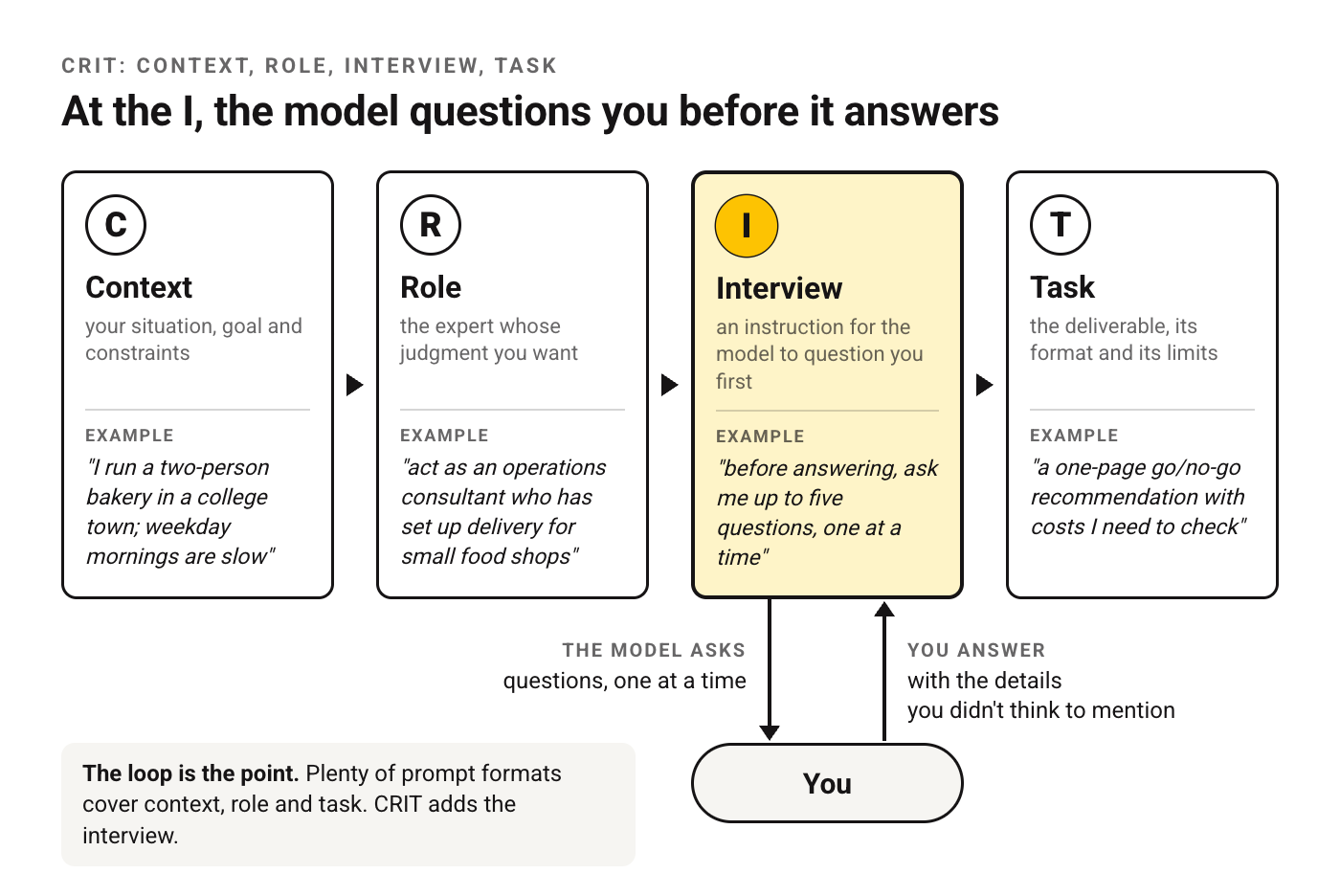
A CRIT AI prompt has four parts: Context, Role, Interview, Task. You describe your situation, tell the model who to be, let it ask you questions, and only then say what you want it to produce.
The third step is the whole point. Plenty of prompt formats cover context, role and task. CRIT adds a round where the model interviews you before it answers, which is how it gets hold of the details you didn't think to mention.
Below: what each letter asks for, a template you can fill in, one prompt taken all the way through the interview, and six CRIT prompts for different jobs.
What CRIT Stands For
| Letter | What you write | Too thin | Enough to work with |
|---|---|---|---|
| C, Context | your situation, goal and constraints, in a short paragraph | "I run a business" | "I run a two-person bakery in a college town; weekday mornings are slow" |
| R, Role | the expert whose judgment you want | "be helpful" | "act as an operations consultant who has set up delivery for small food shops" |
| I, Interview | an instruction for the model to question you first | (missing) | "before answering, ask me up to five questions, one at a time" |
| T, Task | the deliverable, its format and its limits | "give me ideas" | "a one-page go/no-go recommendation with costs I need to check" |
The framework comes from Geoff Woods, author of The AI-Driven Leader. A YPO write-up of his summit talk describes CRIT as four steps (context, role, interview, task) and stresses the interview: the AI questions the leader instead of answering straight away. The book's retail listing names it the same way and marks CRIT as a trademark.
One wrinkle you'll run into. Some write-ups spell the third letter as "Interrogation", among them a CRIT prompting guide from CIT Solutions. Same idea: the model asks before it answers. The author's own wording is Interview.
The Fill-In CRIT Template
Copy it, replace the brackets, send it as one message.
CONTEXT:
[Who you are, what you're working on, the goal, the deadline, what you've already tried, and any hard limits like budget or headcount.]

ROLE:
Act as [specific expert, e.g. "a pricing consultant for small service businesses"]. Judge my situation the way that person would.

INTERVIEW:
Before you give any answer, ask me questions that would change your advice. Ask one at a time and wait for my reply. Stop when you have enough, or after five questions.

TASK:
Then produce [deliverable] for [audience]. Format: [table / one page / bullet plan]. Flag any assumption you had to make.
One message or two? One works fine, and it keeps everything in a single place you can save and reuse. Splitting it (context and role first, then the task after the interview) helps only when the task itself depends on what the questions uncover.
Writing a good context paragraph is the slowest part. If you want help with it, our generator can turn a rough request into a first draft that you then trim to the facts that matter.
One CRIT Prompt, Start to Finish
Here's a full run. We wrote the exchange ourselves to show the shape. Your model will ask different questions, and that's the idea.
The prompt:
CONTEXT:
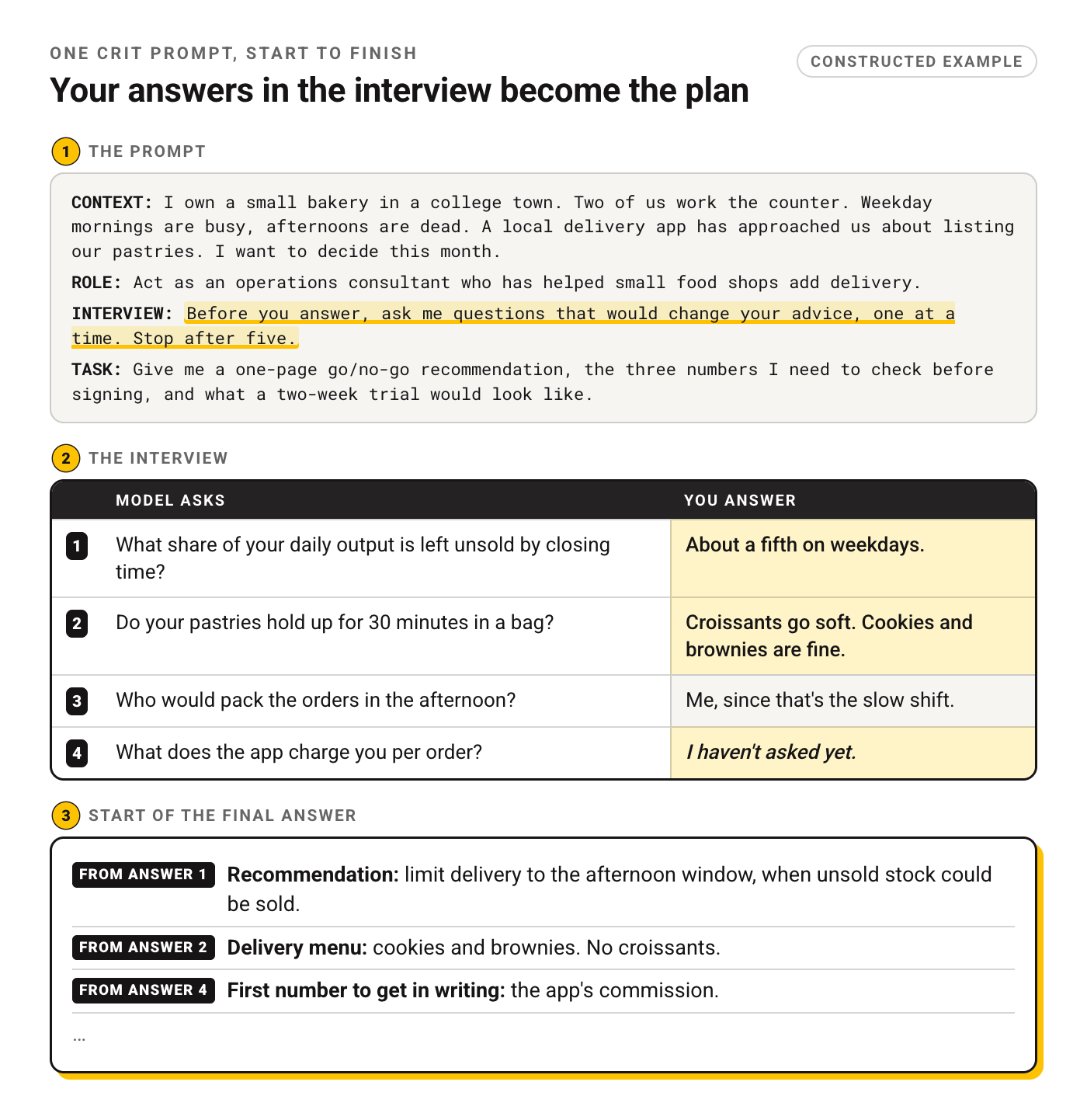
I own a small bakery in a college town. Two of us work the counter. Weekday mornings are busy, afternoons are dead. A local delivery app has approached us about listing our pastries. I want to decide this month.

ROLE:
Act as an operations consultant who has helped small food shops add delivery.

INTERVIEW:
Before you answer, ask me questions that would change your advice, one at a time. Stop after five.

TASK:
Give me a one-page go/no-go recommendation, the three numbers I need to check before signing, and what a two-week trial would look like.
What the interview might look like:
- Model: What share of your daily output is left unsold by closing time? You: About a fifth on weekdays.
- Model: Do your pastries hold up for 30 minutes in a bag? You: Croissants go soft. Cookies and brownies are fine.
- Model: Who would pack the orders in the afternoon? You: Me, since that's the slow shift.
- Model: What does the app charge you per order? You: I haven't asked yet.
Look at what changed. Question one turns an afternoon lull into a reason to say yes: unsold stock could be sold. Question two cuts the menu down to items that travel. Question four is the gap you'd have signed without noticing.
What the final answer should now contain: a recommendation limited to the afternoon window, a delivery menu without croissants, and the app's commission listed as the first number to get in writing. A one-line prompt ("should my bakery use a delivery app?") has none of those inputs to work with, so it can't give you any of them.
Six CRIT AI Prompt Examples You Can Copy
Each one is complete. Swap the bracketed parts for your own details and keep the interview line as written: it's the easiest line to cut and the one doing the most work.
1. Pricing decision
CONTEXT: I run [business] and charge [current price] for [service]. Costs have gone up by about [amount] this year. Most of my clients are [type]. I'm worried about losing [specific client or segment].
ROLE: Act as a pricing consultant for small service businesses.
INTERVIEW: Ask me up to five questions, one at a time, before giving advice.
TASK: Recommend a new price or price structure, a script for telling existing clients, and the warning signs that would tell me I went too far.
2. Prepare for a job interview at a company you've researched
CONTEXT: I have an interview for [role] at [company] on [date]. Here's the job description: [paste]. My background: [two or three lines]. My weak spot for this role is [gap].
ROLE: Act as a hiring manager for this exact role.
INTERVIEW: Before helping, ask me three questions about my experience, one at a time.
TASK: Give me the eight questions you'd most likely ask, a short answer outline for each built from my replies, and two questions I should ask you at the end.
3. Email campaign
CONTEXT: I sell [product] to [audience]. We're launching [offer] on [date]. Past emails that worked: [describe or paste]. Our list size and rough open rate: [numbers if you have them].
ROLE: Act as an email marketer who writes for small brands.
INTERVIEW: Ask me up to four questions about the audience and the offer, one at a time.
TASK: Write a three-email sequence (announcement, reminder, last call) with subject lines under 50 characters and one clear call to action each.
4. Learn a skill in eight weeks
CONTEXT: I want to learn [skill] for [reason]. I can spend [hours] a week. What I already know: [level]. I learn best by [reading / doing / video].
ROLE: Act as a tutor who designs short, practical study plans.
INTERVIEW: Ask me three questions about my goal and schedule, one at a time.
TASK: Build an eight-week plan with one small project per week and a way to check my progress at weeks 4 and 8.
5. Stress-test a decision
CONTEXT: I'm about to decide [decision]. My current reasoning: [paste your reasons]. What's at stake if I'm wrong: [consequence].
ROLE: Act as a critical thinker whose job is to find the flaw in my reasoning, not to agree with me.
INTERVIEW: Ask me questions that expose assumptions I haven't stated, one at a time, until you've found at least three.
TASK: List the assumptions you found, rate each as safe, shaky or unsupported, and tell me what I'd need to know to firm up the shaky ones.
6. Difficult message to someone on your team
CONTEXT: I manage [person/role]. The issue is [specific behavior], it has happened [how often], and it affects [who/what]. Our relationship is [good / strained / new].
ROLE: Act as an experienced people manager who gives direct, kind feedback.
INTERVIEW: Ask me up to four questions about the situation, one at a time.
TASK: Draft what I'll say in the first two minutes of the conversation, and how to respond if they get defensive.
Example 5 doubles as a critical-thinking prompt for anything: a business plan, an essay argument, a big purchase. The interview line is what makes it uncomfortable, and that discomfort is useful.
When CRIT Is Overkill
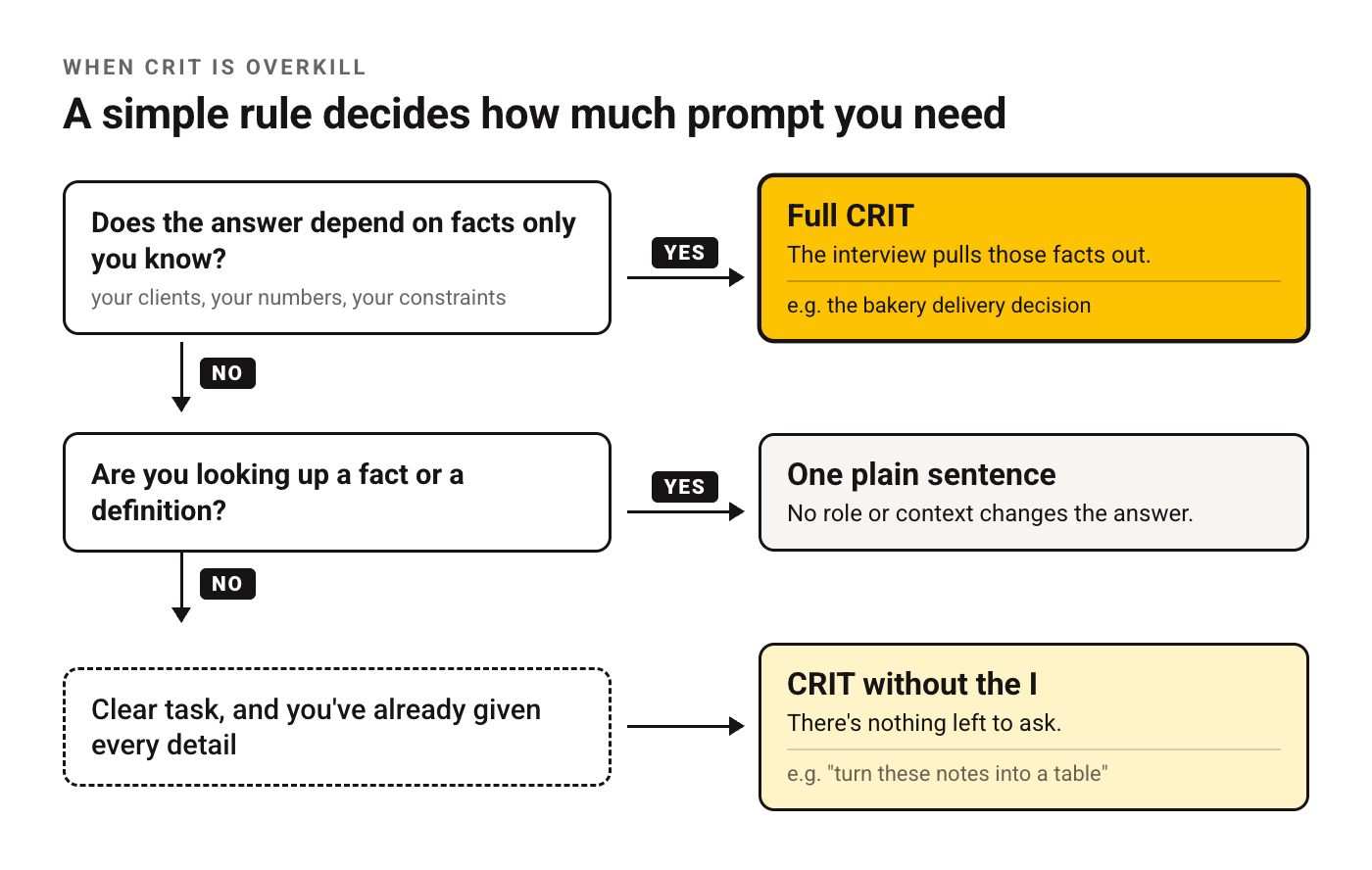
CRIT takes a few minutes to fill in and a few more to answer the questions. That's worth it for some tasks and a waste for others. A simple rule decides.
| Your task | Use | Why |
|---|---|---|
| The answer depends on facts only you know (your clients, your numbers, your constraints) | full CRIT | the interview pulls those facts out |
| Clear task, you've already given every detail | CRIT without the I | there's nothing left to ask |
| Looking up a fact or a definition | one plain sentence | no role or context changes the answer |
The bakery decision was the first case. A request like "turn these notes into a table" is the second. If you're curious how CRIT compares with role-task-format and similar formats, we've broken down seven other formats separately.
Make CRIT Faster to Reuse
The context paragraph barely changes between tasks. Same business, same audience, same limits. So write it once and stop retyping it.
In ChatGPT, that paragraph can live in your custom instructions, and every new chat starts with it. In any other model, keep it in a note and paste it at the top. If you want to understand why the context paragraph carries so much weight, that's a good next read.
Frequently Asked Questions
What does crit mean in AI?
In prompting, CRIT stands for Context, Role, Interview, Task. Separately, there's an open-source developer tool called Crit for reviewing what coding agents produce, which is unrelated to the framework.
What is the crit method?
Another name for the same four steps. The template above is the method in copy-paste form, so you can skip straight to filling it in.
What are some effective AI prompts for critical thinking?
Ones that make the model argue against you. Example 5 above is built for it: give your reasoning, ask the model to act as a critic, and make it question your unstated assumptions before it judges anything. Two follow-ups to try afterwards: "What would someone who disagrees with me say first?" and "Which of my assumptions would be most expensive to get wrong?"
What are some really good AI prompts?
Ones written for a specific situation. A generic prompt gets a generic answer, which is the problem CRIT exists to fix. Start from the six examples above, or from the prompt engineering guide if you want the principles behind them.
Your Move
Pick the decision you've been putting off this week. Fill in the template, send it, and answer the questions honestly, including "I don't know".
The questions you can't answer are often the most useful part of the whole exchange.
Put this into practice: browse strategy prompts and marketing prompts in the God of Prompt library. Copy, paste, run.
Want to run CRIT on every model you use? The AI Starter Pack explains each major model in plain steps and includes the ChatGPT Custom Instructions Pack, so your context paragraph is set up once.
Prompts for this topic
Put this article to work with ready-to-use prompts from the God of Prompt library.
Keep reading
Prompt Caching Explained: Claude, OpenAI, Gemini (2026)
How prompt caching works on Claude, OpenAI, Gemini and Bedrock: minimum lengths, cache lifetimes, prices and a worked example of what a cached prefix saves.

Claude Prompting Best Practices: 10 Before-and-After Fixes
Claude prompting best practices shown as 10 before-and-after rewrites for everyday tasks, plus the fixes each current Claude model needs, with sources.
LLM Prompts: 14 Ready-to-Use Templates for Any Model
14 copy-paste LLM prompts for summaries, data extraction, critique and system prompts, written to run in ChatGPT, Claude, Gemini or a local model.

The best of the blog, in your inbox
One email when notable prompts, tools, and model updates land. No spam, unsubscribe anytime.
Join 100,000+ subscribers. One email a week, real prompts, tools, and model updates. Unsubscribe anytime.