Socratic Prompting: 10 Prompts for Learning and Testing AI Answers
What Socratic prompting is, the six question types behind it, and 10 prompts that make ChatGPT or Claude question you or question its own answers.

On this page
- What Is Socratic Prompting?
- Six Socratic Moves, Six Prompts
- 1. Definition
- 2. Elenchus
- 3. Dialectic
- 4. Maieutics
- 5. Generalization
- 6. Counterfactual reasoning
- Let the AI Question You (Prompts 7 and 8)
- 7. The Socratic tutor
- 8. The decision interview
- Question the AI's Answer (Prompts 9 and 10)
- 9. Find the weakest step
- 10. Argue the other side
- When Socratic Prompting Gets in the Way
- Frequently Asked Questions
- What does Socratic prompting mean?
- What is Socratic questioning?
- What are Socratic prompts?
- What is the Socratic method in AI?
- Your Move
Socratic prompting is a way of prompting where questions do the work: the model questions you, or you question the model's answer. It borrows from the Socratic method, which Wikipedia's entry on it describes as a form of argumentative dialogue in which one person probes a conversation partner with questions and clarifications until the partner comes to a conclusion on their own. This page has 10 prompts that put it to use in ChatGPT, Claude or any chat model. Six of them follow the question types named in a 2023 paper on the subject.
What Is Socratic Prompting?
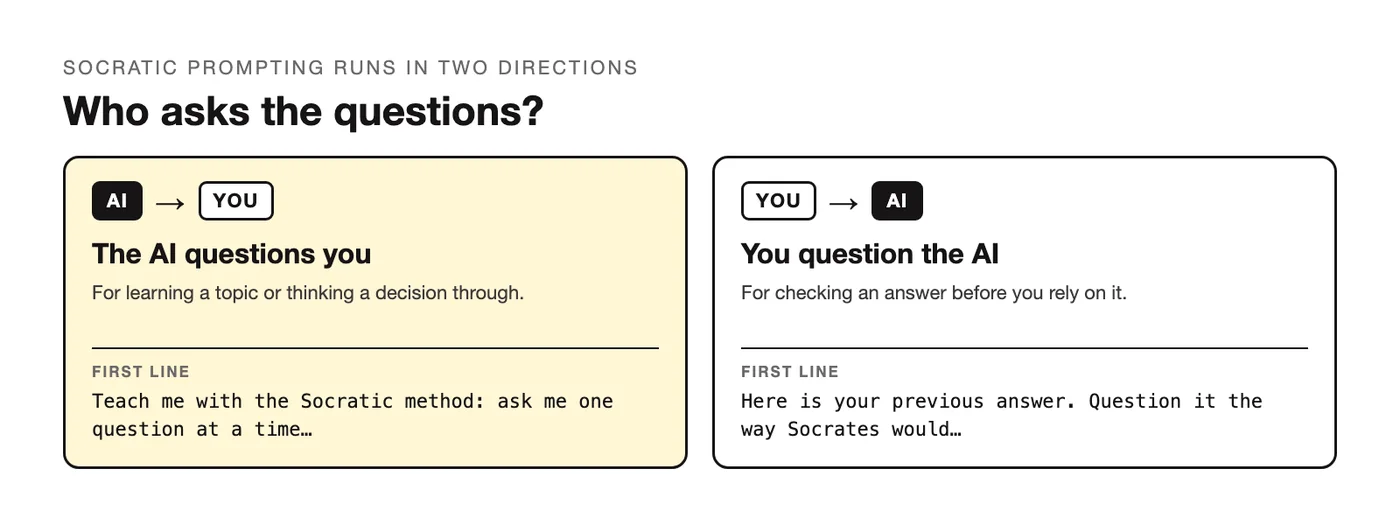
A normal prompt asks for an answer. In Socratic prompting, AI is asked for a line of questioning, and it runs in one of two directions:
- The AI questions you. Use this to learn a topic or think a decision through. The model asks one question at a time and builds on what you say. OpenAI's help page for study mode in ChatGPT calls this "a Socratic-style approach": guiding you with questions before giving the answer.
- You question the AI. Use this to check an answer you've been given. The model has to find the claim its answer rests on and test it.
This is a different tool from role prompts that simulate an expert. A role changes who answers. A Socratic prompt changes who asks.
Six Socratic Moves, Six Prompts
Each Socratic prompting template here uses one technique from Edward Y. Chang's paper Prompting Large Language Models With the Socratic Method, which discusses definition, elenchus, dialectic, maieutics, generalization and counterfactual reasoning as material for prompt templates.
1. Definition
The paper's first technique: clarify the meaning of key terms and concepts before anything else.
Before you answer my question about [topic], list the three terms in it that people define differently. Give the definition you'll use for each in one sentence and ask me whether I mean the same thing. Then wait for my reply.2. Elenchus
Cross-examination: a series of questions that tests whether a belief is consistent and coherent, so you end up with a better-supported position.
Here's what I believe about [topic]: [your position]. Cross-examine it. Ask me one question at a time that tests whether my reasons are consistent with each other, and point out a contradiction as soon as one appears. Don't tell me what to think.3. Dialectic
Opposing viewpoints, worked through as a dialogue to reach a deeper understanding of the subject.
Take this question: [question]. Write the strongest case for one side and the strongest case for the opposite side as a short dialogue between two people who both know the subject. End with what they'd still disagree on and what evidence would settle it.4. Maieutics
Questions that bring out the knowledge you already have and make you reflect on it.
I need to work out [decision or problem]. Don't advise me yet. Ask me questions, one at a time, that help me say what I already know about it: my experience, my constraints, what I've tried. After five answers, summarize what I told you, using my own words.5. Generalization
From a set of cases to a general principle.
Here are [three] cases: [paste examples]. What general rule fits all of them? State it in one sentence. Then tell me which of my cases supports it least, and give one new case that would break the rule.6. Counterfactual reasoning
"What if" questions that imagine alternative scenarios for a plan or an answer.
Here's my plan: [paste]. Run three what-if tests on it: what if my main assumption is wrong, what if it takes twice as long, and what if I'd chosen the opposite approach. For each one, say what would change and what I should check now.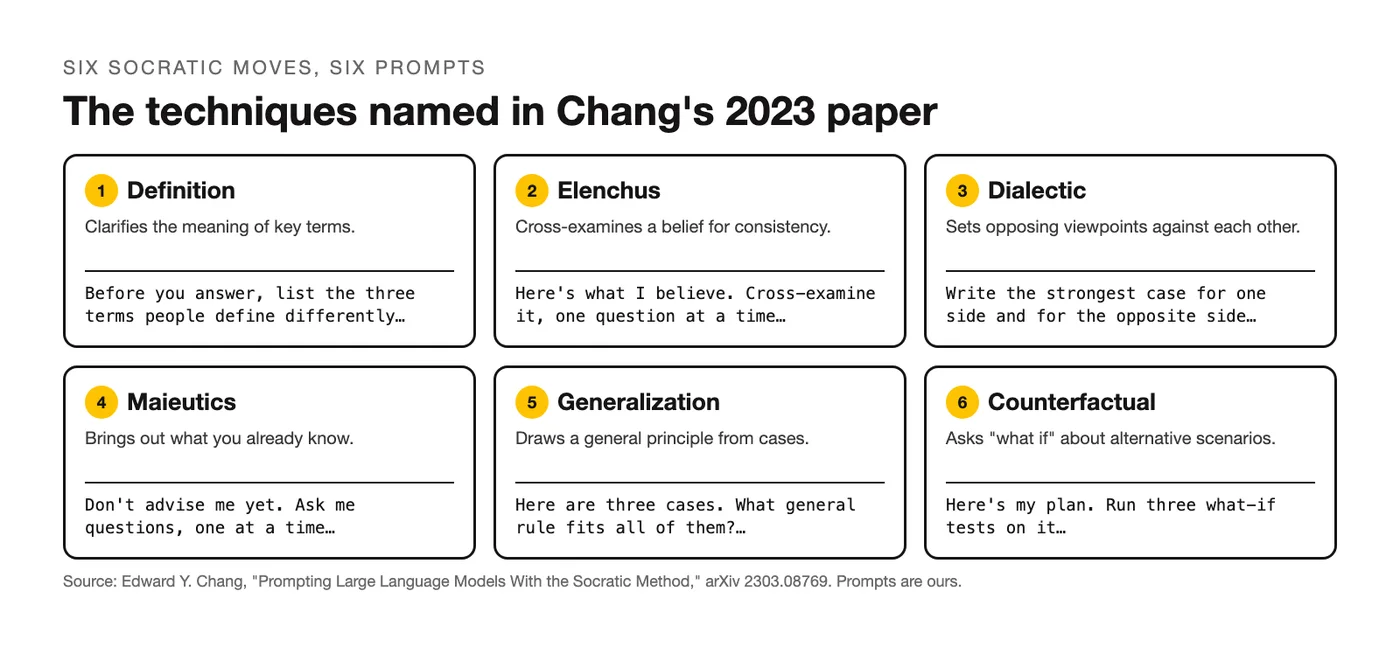
Let the AI Question You (Prompts 7 and 8)
7. The Socratic tutor
For a topic you want to understand and keep.
I want to understand [topic] properly, so don't hand me the answer. Teach me with the Socratic method: ask me one question at a time, wait for my reply, and build the next question on what I said. Don't give the full explanation unless I ask for it twice. Start by asking what I already know.8. The decision interview
For the week before a purchase, a hire or a signature.
I'm about to [buy / hire / sign] [what]. Before I do, interview me about the decision. Ask one question at a time about what I need, what I've compared, what it costs me if I'm wrong and what would change my mind. After six questions, tell me which of my answers was weakest.The library has more in this direction: tutoring prompts and study guide prompts.
Question the AI's Answer (Prompts 9 and 10)
9. Find the weakest step
Paste an answer you're about to rely on.
Here is your previous answer: [paste]. Question it the way Socrates would: pick the claim it depends on most, ask what would have to be true for that claim to hold, and give one concrete case where it fails. Then rewrite the answer so it survives that case.10. Argue the other side
For a recommendation that came too easily.
You just recommended [recommendation]. Now argue against it as someone who knows the subject as well as you do. Give their three best objections, say which one you can't fully answer, and tell me whether your recommendation changes.Both work on top of chain of thought prompting: that technique gets the steps written out, and these two question them.
When Socratic Prompting Gets in the Way
Questions cost turns, so skip the method when:
- You need a fact. A date, a definition or a conversion calls for an answer and a source.
- The task is urgent. Ask for the result first and question it later if it matters.
- You want code or a draft. Get the output, then run prompt 9 on it.
For work where the model has to look things up and act, there's ReAct prompting, and for improving the prompt itself there's meta prompting.
Frequently Asked Questions
What does Socratic prompting mean?
It means the conversation runs on questions. The chat takes more turns, you do more of the thinking, and the model's job shifts from answering to asking or to defending what it said.
What is Socratic questioning?
It's the questioning half of the Socratic method: a run of questions about definitions, reasons, evidence and consequences that continues until a view holds up or changes. Wikipedia notes the method is also known as the maieutic method or the Socratic dialectic.
What are Socratic prompts?
They're prompts that set up that questioning inside a chat. Some hand the questions to the model, like the tutor in prompt 7. Others aim them at the model's own output, like prompt 9. Each of the six templates above uses one question type.
What is the Socratic method in AI?
It's the use of Socratic techniques in prompts for language models. Chang's 2023 paper is one reference point, since it examines those techniques for building prompt templates. Products use the idea too, as study mode in ChatGPT shows.
Your Move
Take one answer an AI gave you this week and run prompt 9 on it. Then try prompt 7 on a topic you half know, and stop when a question makes you look something up.
Put this into practice: browse the tutoring prompts in the God of Prompt library. The prompt engineering guide covers the rest of the techniques with examples.
Prompts for this topic
Put this article to work with ready-to-use prompts from the God of Prompt library.
Keep reading
Smart Prompts: 20 Prompts That Make the Model Think Before It Answers
A smart prompt makes the model plan, check and ask before it writes. These 20 do that for everyday tasks, from a decision memo to a bug fix, and they work in ChatGPT, Claude and Gemini.


Best User-Friendly Prompt Libraries Without Learning Curve
Compare three user-friendly prompt libraries — curated bundles, a ChatGPT extension, and a free community site — to find the best fit for your workflow.
Real Experience Testing Major Prompt Library Platforms
Explore the pros and cons of major AI prompt libraries to find the best fit for your needs, from team collaboration to budget-friendly options.

The best of the blog, in your inbox
One email when notable prompts, tools, and model updates land. No spam, unsubscribe anytime.
Join 100,000+ subscribers. One email a week, real prompts, tools, and model updates. Unsubscribe anytime.