Email security used to assume one primary reader: a person. Attackers wrote messages to influence human judgment, defenders looked for malicious links, attachments, spoofing, and suspicious language, and users were trained to notice urgency or awkward phrasing. Generative AI is changing that model because more inbox content is now consumed by software before a person acts on it.
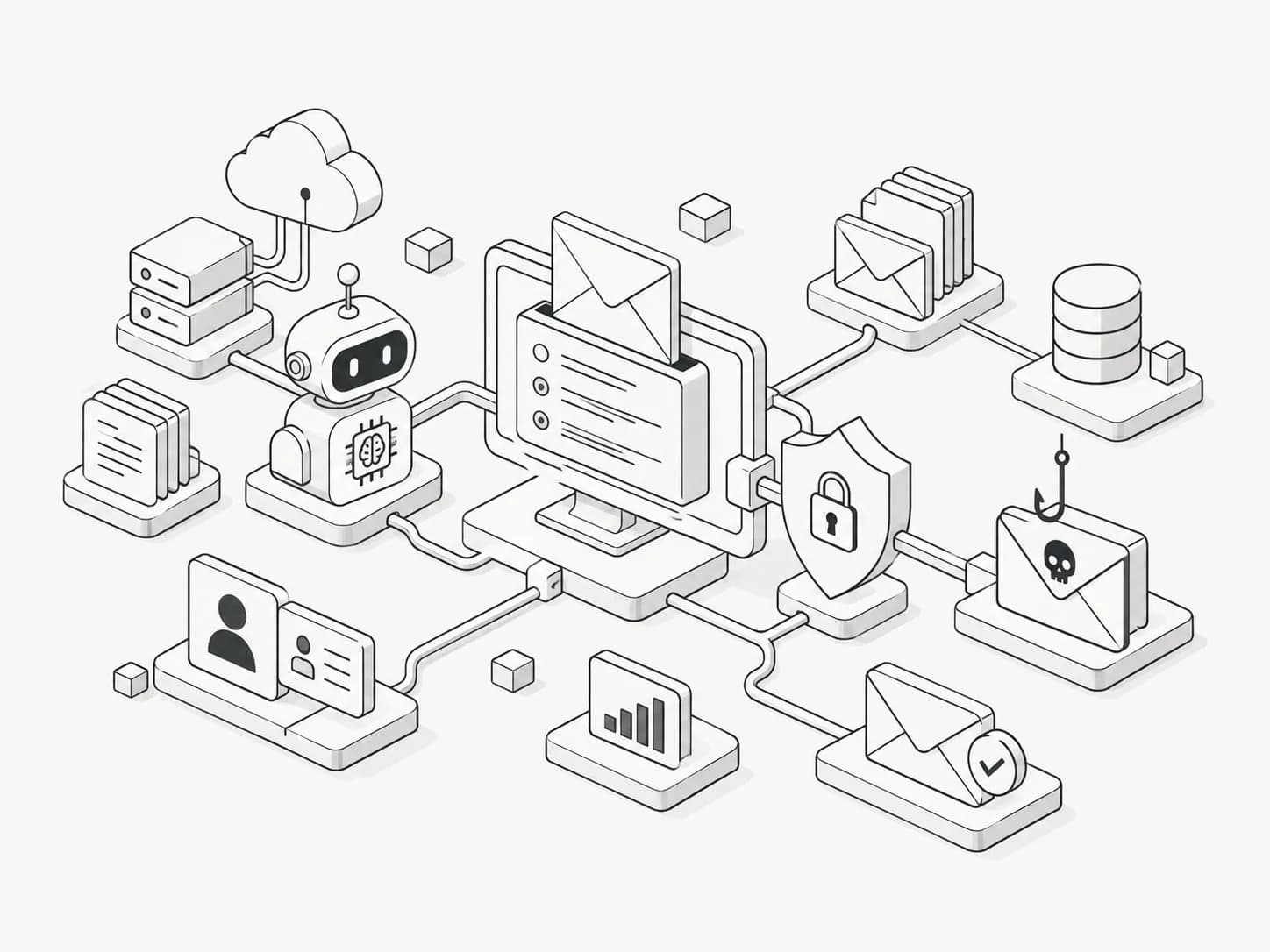
AI assistants summarize threads, extract action items, suggest replies, create calendar events, update CRM records, and route requests into other systems. That changes the security meaning of an email. A message is no longer only content to be read; in an automated workflow, it can become input to a system with access to tools and data.
Every email can have two audiences
A convincing phishing message traditionally needed to persuade the recipient. In an AI-assisted workflow, the attacker may also care about how the message is interpreted by the model processing it. The same email can contain a believable business request for the human and instructions designed to steer an assistant toward a different action.
Humans and AI systems do not necessarily notice the same suspicious features. A human may question an unusual request but ignore hidden or low-salience text, while a model can process every token supplied to its context. Meanwhile, the model may miss the business significance of a familiar-looking request.
A 2026 spear-phishing study found that fully automated AI-generated phishing emails achieved click-through rates comparable to human experts in its controlled experiment. The significance is economic as much as linguistic: personalization becomes cheaper to produce at scale. Writing quality is therefore becoming a weaker trust signal.
The inbox can become an instruction channel
The bigger change appears when an AI system can act. Suppose an assistant can read a mailbox, summarize customer requests, create tickets, update a sales record, or schedule a meeting. The message body is now part of an automated decision path.
This creates a close relationship with prompt injection attacks. Malicious instructions do not have to arrive through a chatbot interface; they can be embedded in documents, webpages, tickets, or emails that an AI system is asked to process. If the application treats all retrieved text as equally trustworthy, untrusted content can compete with the instructions that define the assistant’s job.
The security boundary therefore cannot be “the model was told not to follow suspicious instructions.” The application needs to know what came from the sender, what came from system policy, and which actions the assistant is authorized to take. A message should be able to influence a draft without automatically gaining authority to send it, change an account, or expose unrelated data.
Language is becoming less useful than relationship context
Traditional anti-phishing advice often emphasizes spelling errors, unusual grammar, generic greetings, or awkward tone. Those clues still exist, but generative AI makes them easier to remove. Attackers can reproduce professional language, imitate a role, and generate many tailored variants without writing each one manually.
The stronger signals increasingly sit outside the prose. Does the sender normally communicate with this recipient? Has this mailbox previously requested this action? Is the reply-to path consistent with the sender identity? Did the message introduce a new payment destination, credential request, file-sharing path, or authentication flow?
That is where Email Security Services take on a broader role in AI-enabled workplaces. The useful control is no longer only “is this message malicious?” but “should this message be allowed to influence a person, an AI assistant, or an automated business action in this context?” Evaluate identity, behavior, content, links, attachments, and workflow signals together.
Suggestion and execution should be separate
One of the safest patterns for AI-enabled email workflows is to separate suggestion from execution. An assistant may summarize a message, classify intent, recommend a response, or propose a calendar event. The application should make a separate authorization decision before taking any consequential action.
A valid-looking model output does not prove the underlying request is legitimate. Structured output and fluent explanations can still be produced after the model has been influenced by malicious or misleading input. A tool call generated from email content should therefore be treated as a proposal from an untrusted source, not as an authorization.
Risk should determine how much friction is added. Drafting a reply may require little intervention, while sending externally, changing payment details, granting access, or exporting customer data should trigger stronger verification. The goal is to keep irreversible authority outside the language model without making automation unusable.
Email provenance needs to survive automation
As inbox workflows become more automated, provenance becomes important. Security systems should preserve who sent the message, how the sender was authenticated, which links or files were present, what content the model consumed, what action it proposed, and which policy allowed or rejected the next step. Otherwise, investigators may see a legitimate API call without understanding that it originated from an untrusted email.
Provenance also helps with false positives. A suspicious phrase may be harmless if it comes from a known workflow and results only in a low-risk draft. The same phrase matters more if it arrives from a new sender and attempts to trigger an external transfer or privilege change.
The inbox is becoming part of the application boundary
Email is no longer just a communication channel. In AI-enabled organizations, it is becoming a source of machine-readable instructions that can influence downstream systems. Email security must therefore protect both human judgment and automated execution.
The most important design question is changing from “Can the user spot the phishing email?” to “What can this message cause if neither the user nor the model recognizes it as hostile?” That question forces security teams to consider sender identity, relationship context, data access, tool permissions, and confirmation boundaries together.
As AI assistants become more capable, the safest inbox will not be the one that assumes every malicious message can be identified perfectly. It will be the one where an untrusted message can still be read, summarized, and handled without being able to silently turn language into authority.