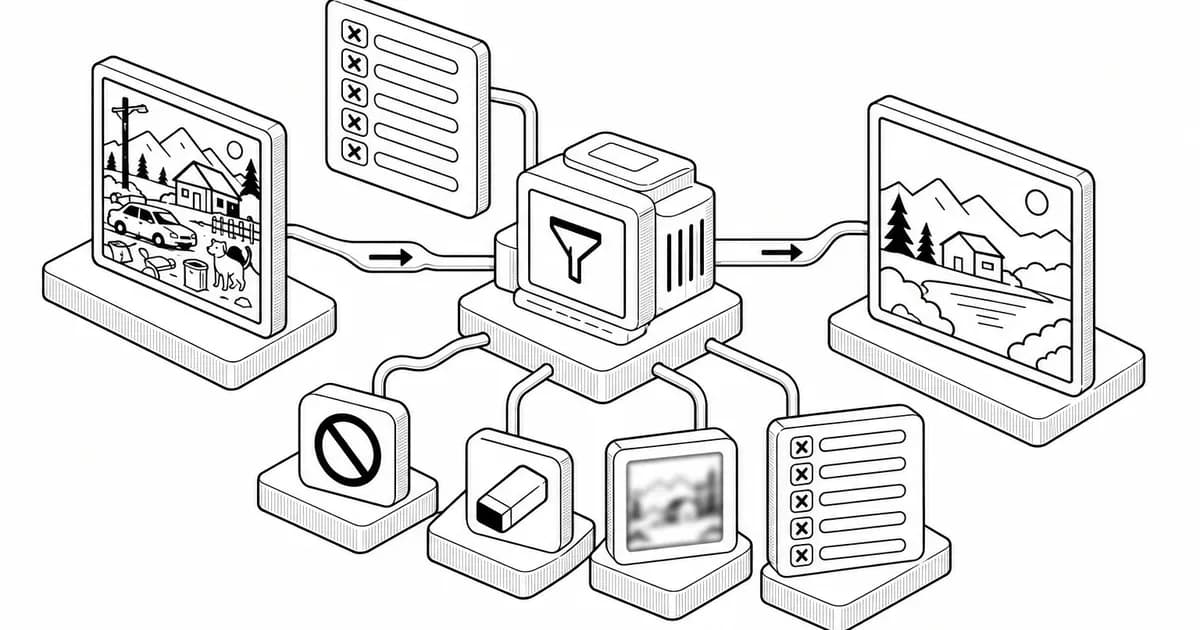
A negative prompt is a second list you give an image model: the things that must not appear. Extra fingers, text, watermarks, blur, a second person, a cartoon style when you wanted a photo. The idea is simple and the behaviour is uneven, because the models handle negatives in three different ways, and a negative prompt that is essential in one is ignored in another. This guide explains which is which, then gives fifty negatives grouped by the problem they solve.
How each model handles negative prompts
Stable Diffusion and its descendants (SDXL, the community models, most local setups) have a real negative prompt field. The model is steered away from the concepts in it at every step, and the field matters as much as the positive prompt. This is where negative prompts came from and where they work best.
Midjourney has the --no parameter. It works for concrete objects and colours ("--no text, people, red") and is weaker for abstract qualities ("--no ugly" does little). Weighted negatives are possible with the ::-0.5 syntax but rarely needed.
Flux, Nano Banana, DALL-E, Ideogram and the newer prompt-following models mostly have no negative field. They read a plain-language instruction instead, and "no text, no watermark, plain background" inside the main prompt is the negative prompt. Writing "ugly, deformed, bad anatomy" into these models does nothing or, in some, adds the thing you named. The rule for this group: say what you do want with enough precision that the unwanted thing has no room, and add a short, plain "no X" where it keeps appearing.
When a negative prompt works and when it does not
It works for things the model would otherwise add by habit: text and watermarks on anything that looks like a poster, a second figure in a portrait, a frame or border, a hand in the foreground, a specific colour that keeps bleeding in. It works for style collisions: "cartoon, illustration, anime" when you want a photograph, or "photo, realistic" when you want a flat illustration.
It does nothing for quality in general. "Low quality, worst quality, blurry" in the negative field is folk tradition from early Stable Diffusion and has little effect in current models, which do not have a concept of "worst quality" to avoid. Fix quality in the positive prompt with a lens, a light and a render word instead. It also does nothing for things the positive prompt is demanding: "no people" with "a busy street market" is a contradiction, and the positive wins.
50 negative prompts by problem
Each group is written for the Stable Diffusion field and Midjourney's --no; for the plain-language models, use the "say instead" line.
Text and marks
Negative: text, letters, words, watermark, signature, logo, caption, subtitle, frame, border. Say instead: "no text or watermark anywhere, clean edges, nothing written in the image."
Hands and anatomy
Negative: extra fingers, missing fingers, fused fingers, extra limbs, extra arms, extra legs, deformed hands, long neck, cross-eyed. Say instead: describe the pose so the hands are simple or hidden: "hands in pockets," "holding a cup with both hands," "arms crossed."
Extra people and objects
Negative: second person, crowd, people in background, duplicate, twins, mirror, reflection, extra object. Say instead: "one person, alone, empty background, no one else in frame."
Style collisions (wanting a photo)
Negative: cartoon, anime, illustration, painting, drawing, 3d render, cgi, doll, plastic skin, airbrushed. Say instead: "photograph, 35mm, natural skin texture, candid."
Style collisions (wanting an illustration)
Negative: photo, photorealistic, realistic, camera, lens, bokeh. Say instead: "flat vector illustration, two colours, clean lines, no gradients."
Composition
Negative: cropped, out of frame, cut off head, tilted, dutch angle, split screen, collage, grid, multiple panels. Say instead: "single image, full subject in frame, straight horizon, centered."
Colour and tone
Negative: oversaturated, neon, high contrast, hdr, vignette, color cast, yellow tint, sepia. Say instead: "natural colour, soft contrast, neutral white balance."
Background
Negative: busy background, clutter, pattern, wallpaper, trees, buildings (name what keeps appearing). Say instead: "plain grey studio background, nothing behind the subject."
Faces (when consistency matters)
Negative: asymmetric eyes, different eye colours, extra teeth, open mouth, makeup (adjust to the case). Say instead: "neutral expression, mouth closed, looking at camera, natural makeup."
Products
Negative: reflection on label, fingerprints, dust, shadow on product, extra products, hand, price tag. Say instead: "one product, label clean and readable, soft shadow beneath, nothing else in frame."
A working negative prompt for Stable Diffusion
text, watermark, signature, logo, frame, border, extra fingers, deformed hands, extra limbs, second person, cropped, out of frame, cartoon, anime, illustration, oversaturated, busy background
That is a general-purpose negative for a photographic portrait or product shot. Remove the style line if you want an illustration, and add the one thing that keeps appearing in your results. Keep it under about twenty terms; a long negative prompt dilutes itself and starts fighting the positive prompt.
Midjourney --no examples
--no text, watermark on anything poster-like.--no people for empty interiors and landscapes.--no red when a colour keeps bleeding in.--no frame, border, vignette for clean edges.--no hands when the pose makes hands optional.
Negatives for the plain-language models
In Nano Banana, Flux, DALL-E and Ideogram, put the negative at the end of the prompt as a short, concrete sentence: "No text, no watermark, no other people, plain background." Three or four items at most. Then regenerate once with the unwanted thing described out by the positive prompt: if a second person keeps appearing, write "alone in an empty room" rather than adding more negatives. These models are better at following what you want than at avoiding what you name, and the positive description is the stronger tool.
The art and design prompts in the library carry the right negative for their model where one is needed, and the product photography prompts and portrait prompts show the "say instead" approach in tested form. For the overall structure of an image prompt, the Midjourney prompt formula is the short guide.