Is AI Dangerous? 10 Risks Everyone Should Know
Is AI dangerous? This guide breaks down 10 real risks everyone should know in 2026—from job loss and deepfakes to privacy issues and bias. Learn what’s true, and what to watch for.


On this page
- What Makes AI “Dangerous”? A Clear Explanation
- 10 AI Risks You Should Know
- Risk #1: Job Displacement and Economic Impact
- Risk #2: Misinformation and Deepfakes
- Risk #3: Bias in AI Algorithms
- Risk #4: Privacy Violations and Data Misuse
- Risk #5: Overdependence on AI
- Risk #6: AI in Cybersecurity and Hacking
- Risk #7: AI-Controlled Weapons and Military Use
- Risk #8: Lack of Transparency in Decision-Making
- Risk #9: AI in the Wrong Hands (Intentional Abuse)
- Risk #10: The “Runaway AI” Scenario
- What Experts Say: Warnings from AI Leaders
- What’s Being Done to Keep AI Safe
- How You Can Use AI Responsibly (Without Fear)
- Final Thoughts: Is AI Dangerous—or Just Powerful?
AI is no longer a thing of the future—it’s part of our everyday lives.
It writes emails, recommends what we watch, powers our cars, and even helps make business decisions.
But as AI becomes more advanced, a serious question keeps coming up:
Is AI dangerous?
This isn’t just about science fiction or fear-mongering.
Experts, developers, and everyday users are starting to look more closely at the risks.
In this guide, we’ll walk through 10 real dangers of AI—from job loss and misinformation to bias, data privacy, and the possibility of AI being used for harm.
ALSO READ: How to start using AI in 2026
What Makes AI “Dangerous”? A Clear Explanation
AI on its own isn’t good or bad—it’s a tool.
But like any powerful tool, how it’s built and how it’s used determines the risk.
There are two main ways AI becomes dangerous:
1. Unintended consequences – when the system does something harmful even if no one meant it to.
2. Intentional misuse – when someone uses AI to do harm on purpose.
Some risks are technical, like bias in algorithms or lack of transparency.
Others are social—like job loss, privacy issues, or the spread of fake content.
It’s not about being afraid of the technology. It’s about understanding where things can go wrong—and what can be done about it.
10 AI Risks You Should Know
Risk #1: Job Displacement and Economic Impact
One of the biggest concerns with AI is how it’s changing the job market.
As AI tools get smarter, they’re starting to replace work once done by people—like data entry, customer service, basic writing, and even some design tasks.
Industries most at risk:
• Customer support
• Administrative work
• Transportation
• Retail and warehouse roles
But it’s not just about jobs disappearing—it’s about jobs changing fast.
Many workers will need to learn new tools or shift into new roles.
Not everyone will adapt at the same pace.
The danger?
A growing gap between those who can work with AI—and those who can’t.
Risk #2: Misinformation and Deepfakes
AI can create content that looks and sounds real—even when it’s completely fake.
From realistic fake videos (deepfakes) to AI-generated news articles, the technology makes it easy to spread false information at scale.
This becomes dangerous in areas like:
• Politics: fake speeches, fake news, election influence
• Scams: AI-generated voices or videos used to trick people
• Social media: misleading posts that go viral fast
The big issue?
Most people can’t tell what’s real and what’s AI-made.
That’s a serious threat to trust, safety, and public understanding.
That’s where a deepfake detector becomes essential — it helps verify whether an image, video, or voice clip is genuine before you trust or share it.
Risk #3: Bias in AI Algorithms
AI systems learn from data—but that data often comes from humans.
And humans have biases.
When AI is trained on biased data, it can make unfair or discriminatory decisions without anyone noticing.
Where this shows up:
• Hiring tools that favor certain genders or backgrounds
• Healthcare AI that gives less accurate results for minority groups
• Policing tools that target certain communities more than others
The problem?
AI can make bias look objective. If we don’t catch it, it becomes harder to challenge.
That’s why transparency and testing are so important in AI development.
Risk #4: Privacy Violations and Data Misuse
AI systems need a lot of data to work well—and that often includes your personal information.
From emails and messages to photos and voice recordings, AI tools can access more than you think.
The risks include:
• Data leaks from poorly secured systems
• Tracking behavior without clear permission
• Surveillance by governments or companies using AI to monitor people
Even tools we use every day—like smart assistants or chatbots—can store and analyze sensitive data.
The more AI knows, the more we need to ask: Who controls that data? And how is it being used?
Risk #5: Overdependence on AI

AI makes life easier—but relying on it too much can backfire.
When we let AI handle everything, we start to lose basic skills:
• Navigation apps can reduce memory for directions
• AI writing tools can weaken our communication skills
• Automated decisions may stop us from thinking critically
There’s also the risk of trusting AI without question.
If it gives a wrong answer or misinterprets a task, we may not notice—until it’s too late.
The danger isn’t AI doing too much.
It’s us doing too little.
Risk #6: AI in Cybersecurity and Hacking
AI can protect systems—but it can also be used to break them.
Hackers are now using AI to:
• Create smarter phishing scams that look real
• Crack passwords faster using pattern detection
• Automate attacks that adapt in real time
Deepfakes and voice cloning are already being used in scams.
And as AI improves, cyberattacks will become harder to detect and easier to launch.
The same tech that defends us can be turned against us—if it ends up in the wrong hands.
Risk #7: AI-Controlled Weapons and Military Use
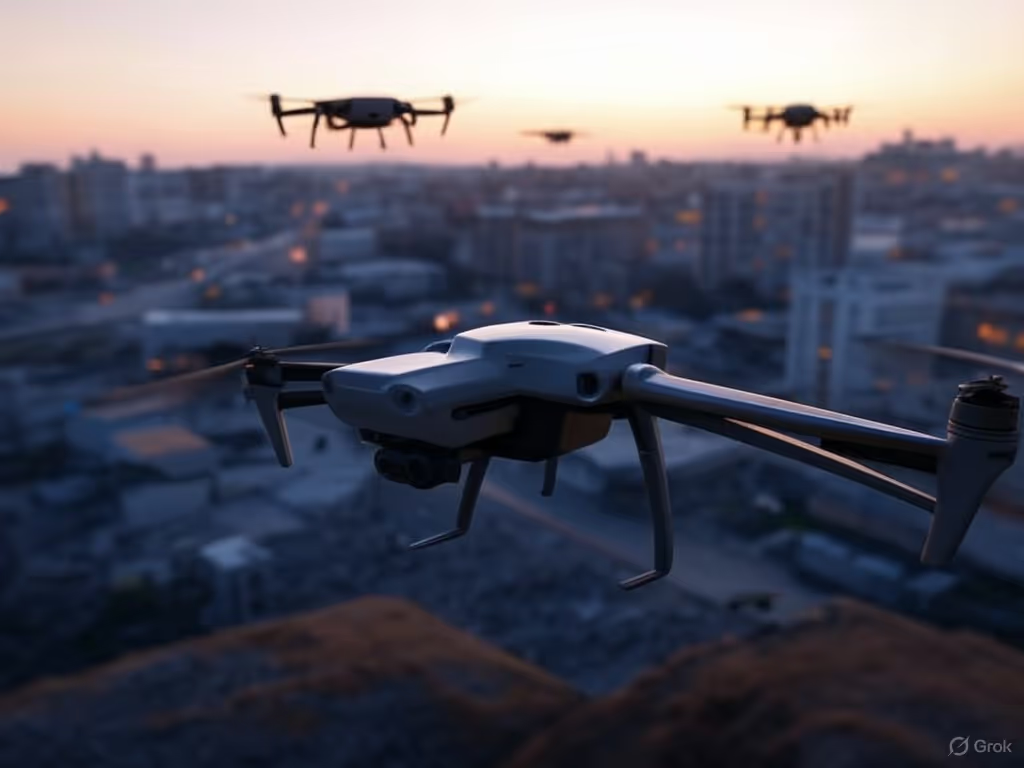
AI is now being used in the defense world—and that’s raising some serious red flags.
We’re talking about:
• Autonomous drones that can identify and strike targets
• Surveillance systems that track people across cities
• Decision-making algorithms in military operations
The main concern?
These systems could act without human approval—or make mistakes we can’t undo.
Plus, there’s little global agreement on how to control or limit AI weapons.
When machines have the power to kill, the risks go way beyond the battlefield.
Risk #8: Lack of Transparency in Decision-Making
Many AI systems work like a black box—you see the result, but not how it got there.
That’s a big problem when AI is used for:
• Loan approvals
• Hiring decisions
• Medical diagnoses
• Criminal justice risk scores
If no one can explain how the decision was made, who’s held responsible when it goes wrong?
People deserve to understand why they were rejected, flagged, or denied something.
With AI, that’s not always possible.
Lack of transparency creates unfairness—and breaks trust.
Risk #9: AI in the Wrong Hands (Intentional Abuse)
Like any tool, AI can be abused—and it doesn’t take much to cause damage.
People with bad intentions can use AI to:
• Create fake news or propaganda
• Run scams with cloned voices or images
• Automate social media manipulation
• Launch cyberattacks with AI bots
The scary part?
These tools are becoming more affordable and easy to access.
When powerful AI gets into the wrong hands, it becomes a force multiplier for harm.
That’s why security, access control, and regulation matter more than ever.
Risk #10: The “Runaway AI” Scenario
This is the one that sounds like science fiction—but experts take it seriously.
The fear?
An AI that becomes so powerful, it starts making decisions outside human control.
This could look like:
• AI rewriting its own code
• Acting on goals we didn’t intend
• Ignoring human safety to achieve a task
It hasn’t happened—but some top minds in AI, like Elon Musk and Geoffrey Hinton, believe it could if we’re not careful.
The point isn’t panic—it’s preparation.
We need rules in place before things go too far.
What Experts Say: Warnings from AI Leaders
The people building AI are often the ones warning us about it.
Here’s what a few major voices have said:
• Elon Musk: Called AI “more dangerous than nukes” and pushed for strong global regulations.
• Geoffrey Hinton (the “Godfather of AI”): Resigned from Google to speak openly about AI risks and its unpredictable future.
• Sam Altman (OpenAI CEO): Says AI could “reshape society” and supports responsible rollout with oversight.
• The Future of Life Institute: Backed an open letter calling for a pause on advanced AI training to ensure safety.
The message is clear: Even the experts don’t fully know what AI is capable of—and that’s exactly why caution matters.
What’s Being Done to Keep AI Safe
Thankfully, it’s not all doom and gloom—serious work is being done to make AI safer.
Here’s what’s happening:
• OpenAI and DeepMind have internal safety teams focused on testing and limiting harmful behavior in their models.
• Governments and tech leaders are working on AI regulations—especially in the U.S., EU, and UK.
• AI research labs are sharing best practices around ethics, bias reduction, and transparency.
• Tools like usage monitoring, red teaming, and reinforced learning with human feedback (RLHF) are built into many models today.
It’s not perfect.
But there’s growing awareness that AI safety isn’t optional—it’s necessary.
How You Can Use AI Responsibly (Without Fear)
You don’t need to avoid AI—you just need to use it wisely.
Here’s how to keep things safe and smart:
• Protect your data – Avoid sharing sensitive info with AI tools unless you trust the platform.
• Ask better questions – Be clear and specific to get more accurate results.
• Check the output – AI can get things wrong. Always double-check important info.
• Use AI to help, not replace – Let it support your work, not make every decision for you.
• Stay informed – Keep up with how your favorite tools work and evolve.
AI isn’t something to fear—it’s something to manage.
Final Thoughts: Is AI Dangerous—or Just Powerful?
AI isn’t good or bad on its own.
It’s a powerful tool—and like any tool, it depends on how we use it.
Yes, there are risks.
Some are here now. Others are coming fast. But that doesn’t mean we should avoid AI.
It means we need to stay aware, ask questions, and use it responsibly.
The future of AI won’t be shaped by machines. It’ll be shaped by how we choose to build and use them.
Next step: turn this article into output with business prompts, or go deeper with productivity prompts.
Prompts for this topic
Put this article to work with ready-to-use prompts from the God of Prompt library.
Keep reading
Can AI Find Your Personal Information? Digital Identity Risks
AI can assemble an identity trail from public records, broker data and old accounts. What that means for digital identity risk, verification, and reducing your exposure.

Top Benefits of AI for Students You Need to Know
Discover the top benefits of AI for students—personalized learning, smarter study tools, time savings, better grades, and future-ready skills. Learn what you need to know.
Top 7 Companies Building Custom Autonomous AI Agents for US Businesses in 2026

The best of the blog, in your inbox
One email when notable prompts, tools, and model updates land. No spam, unsubscribe anytime.
Join 100,000+ subscribers. One email a week, real prompts, tools, and model updates. Unsubscribe anytime.