ChatGPT Cover Letter Prompts That Don't Sound Like AI
A five-step prompt chain that turns your real experience into a cover letter worth reading, plus the exact phrases that give an AI-written one away.


On this page
- Why One-Shot Prompts Fail
- The Five Prompts
- Step 1: Decode the job posting
- Step 2: Mine your own material
- Step 3: Match and cut
- Step 4: Draft
- Step 5: Strip the tells
- The Two Situations That Need Their Own Prompt
- A gap in your employment history
- The letter has to survive an ATS first
- The Phrases That Give It Away
- Frequently Asked Questions
- Can employers detect ChatGPT cover letters?
- What's the best prompt for a cover letter on ChatGPT?
- What's the rule of three in a cover letter?
- How long should it be?
- Should I mention that I used AI?
- Do cover letters need ATS keywords?
- Does this work for resumes too?
- Your Move
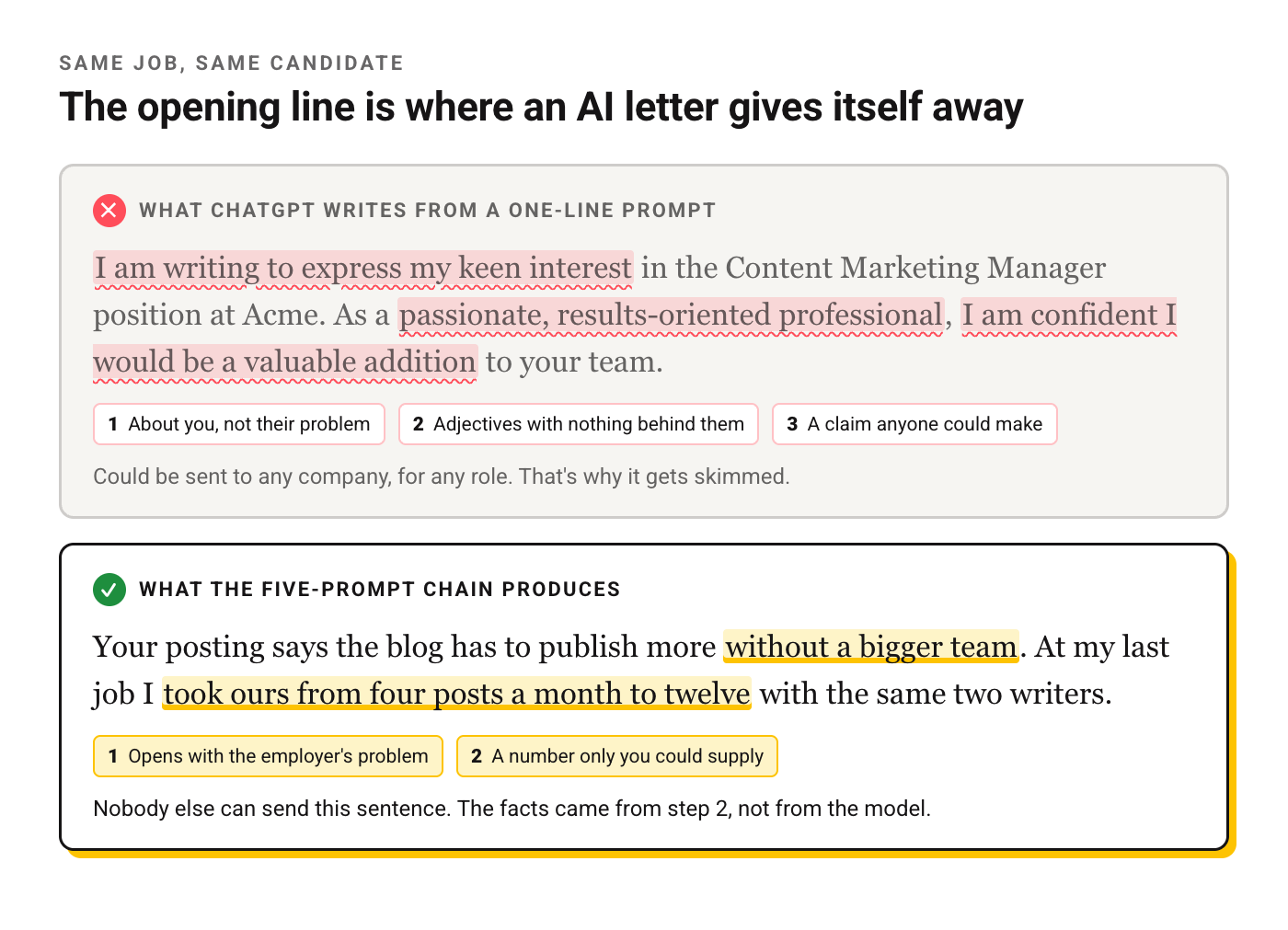
Ask ChatGPT for a cover letter and you'll have one in fifteen seconds. It'll open with "I am writing to express my keen interest in the [Role] position." It'll call you passionate about something. And it'll read exactly like every other letter in that hiring manager's inbox.
The model isn't the problem. The prompt is.
One instruction with no material produces one generic letter, because there's nothing specific in the input for the output to be specific about. Garbage in, beige out.
What follows is a chain of five prompts instead of one, plus two more for the cases that break it. Takes about ten minutes. The difference is that the letter at the end contains facts only you could have supplied.
Why One-Shot Prompts Fail
A single "write me a cover letter for this job" asks the model to do four things at once: work out what the role needs, decide what matters about you, pick a structure, write prose. Give it nothing to work from and it falls back on the average of every cover letter it's ever seen. Which is what you get.
The chain pulls those four apart and adds a fifth, because stripping the machine register out is its own job and doing it in the same breath as writing never works.
| Step | What it produces | Why it's separate |
|---|---|---|
| 1. Decode the posting | What the employer's actually worried about | You can't answer a concern nobody named |
| 2. Mine your material | Three stories with numbers attached | No model can invent this part for you |
| 3. Match and cut | Which story answers which worry | Stops the letter listing everything |
| 4. Draft | The letter | Now there's material to write from |
| 5. Strip the tells | A letter that doesn't read as generated | Register is what gives it away, not vocabulary |
Skip step 2 and you'll land back at "passionate about excellence." Everyone does. It's the step that feels like admin and isn't.
The Five Prompts
Run them in one chat, in order, so each step can see the answers to the one before it.
Step 1: Decode the job posting
Here is a job posting. Don't write anything yet.

Analyze it and tell me:
1. The three problems this employer is actually trying to solve by hiring someone. Read past the responsibilities list. What goes wrong at this company if this role stays empty for six months?
2. Which requirements are genuine filters and which are wishlist padding.
3. The seniority signal: do they want someone to execute, to own, or to build a function from nothing?
4. Any phrase repeated more than once, which usually marks what they care about most.

Job posting:
[PASTE THE FULL POSTING]
The default letter answers the responsibilities list. A strong one answers the problem sitting behind it, and that difference shows up in the first sentence, which is the only sentence guaranteed to be read.
Step 2: Mine your own material
I'm going to describe my experience. Interrogate it. Don't write with it yet.

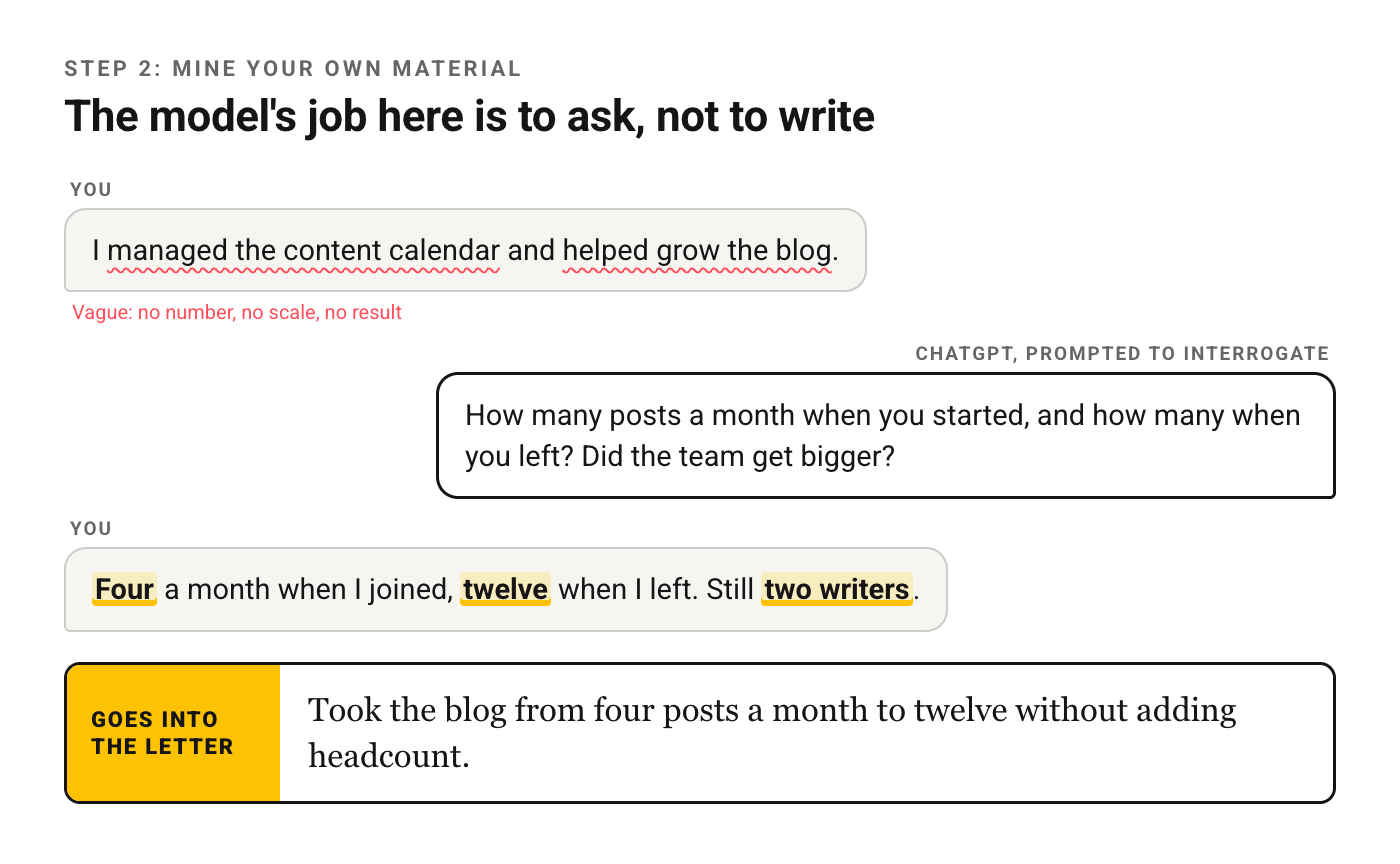
For each thing I tell you, ask me one follow-up question that would surface a number, a timeframe, a scale or a concrete outcome. Keep asking until every item has at least one hard detail attached. Push back when I say something vague like "improved" or "helped with". Those aren't answers.

My experience relevant to this role:
[TWO OR THREE PARAGRAPHS, ROUGH, UNPOLISHED]
This is the step that matters more than the other four combined.
"Managed the content calendar" is invisible. "Took the blog from four posts a month to twelve without adding headcount" is a reason to pick up the phone. ChatGPT can't produce that second sentence unless you hand it the numbers, and being asked for them directly is usually what makes you remember you have them.
Step 3: Match and cut
You now have the employer's three real problems and my experience with hard detail attached.

Map them. For each problem, pick the single strongest thing from my experience that answers it. Rank the three by how directly they land.

Then tell me which impressive thing from my experience does NOT belong in this letter, because it doesn't answer anything this employer is worried about.
The cut is the point. Instinct says include everything strong, but a letter mentioning five achievements says none of them loudly, and asking the model what to drop is faster than deciding yourself. It has no sentimental attachment to your career.
Step 4: Draft
Write the cover letter now. Constraints:

- Under 300 words, four paragraphs maximum.
- Open with the employer's problem, not my interest in the role. Never "I am writing to apply".
- One specific achievement per paragraph, number attached, tied to the matching problem.
- Plain declarative sentences. Nothing over 25 words.
- Banned: passionate, driven, results-oriented, detail-oriented, team player.
- Close with one concrete sentence about what I'd do in the first month. Not a request for an interview.
- Write in my voice, based on how I described my experience. Not formal business register.
Step 5: Strip the tells
Read this letter as a hiring manager who sees forty a week and spots AI writing instantly.

Find and fix:
- Any sentence that could appear in another candidate's letter. Replace it with something only I could write.
- Padding in threes: lists of adjectives where one would do.
- Words like leverage, utilize, spearheaded, robust, dynamic, seamless, delve, tapestry, testament, landscape.
- Long dashes used as pauses, and the "It's not just X, it's Y" construction.
- Any claim with no evidence behind it.
- The opening sentence, if it's about me rather than about them.

Give me the revised letter, then a short list of what you changed and why.
The Two Situations That Need Their Own Prompt
The chain above assumes a straightforward application. Two cases break it, and both come up constantly.
A gap in your employment history
The usual mistakes are ignoring the gap and hoping, or over-explaining it until it becomes the subject. What works is one clause, stated flatly, followed immediately by something else.
I have a gap in my work history: [dates, one-line reason].

Write one sentence that states it plainly, with no apology, no defensiveness, and no justification longer than the fact itself. Then write the sentence that follows it, which must move straight to something I did during or after that period that's relevant to this role.

Two sentences total. If the first one sounds like an excuse, rewrite it.
Career changers need the same treatment, with one difference. The gap version explains absence. The career-change version has to make the previous field look like preparation. That means naming the specific skill that carries over. "The skills are transferable" tells the reader nothing.
The letter has to survive an ATS first
Plenty of applications go through an applicant tracking system before a person sees them. Cover letters get parsed less aggressively than resumes, and the scoring varies by system, so nobody can promise you a number. What's safe to say: if the posting names a specific tool, certification or methodology and your letter never uses that exact string, you're relying entirely on a human to make the connection.
Here is the job posting and my cover letter.

List every hard requirement from the posting that my letter doesn't mention by its exact name: tools, certifications, methodologies, named systems.

For each one I genuinely have, show me where in the letter it fits naturally as part of an achievement I already described. Don't add a skills list. Don't repeat the posting's wording back as a sentence. If a term can't be worked in without sounding forced, tell me to leave it out.
That last instruction matters more than the rest of the prompt. A letter stuffed with matched keywords reads exactly as badly to a human as it scores well to a parser, and the human is the one who decides.
The Phrases That Give It Away
Whether an employer runs a detector barely matters. A reader doesn't need one: the register gives it away first, and these are the reliable tells.
| Tell | How it reads | Write this instead |
|---|---|---|
| Interest-first opening | "I am writing to express my keen interest in..." | One sentence about their problem |
| Stacked adjectives | "a passionate, driven, results-oriented professional" | One achievement with a number |
| Borrowed vocabulary | leverage, spearheaded, robust, seamless | The words you'd use out loud |
| Padding in threes | "strategy, execution and delivery" | Whichever one actually applies |
| The contrast trick | "It's not just about X, it's about Y" | Delete it |
| Empty closing | "I would welcome the opportunity to discuss..." | What you'd do in month one |
| Mirroring the ad | The posting's phrases repeated back at them | Your own words for the same thing |
Quick test before you send. Delete your name and the company name. Could someone else plausibly send this to a different employer? Then it isn't finished.
If that stripping step is the part you keep struggling with, we've got a longer piece on prompts that make ChatGPT write like a human, plus a list of 500 overused ChatGPT words worth keeping open in a second tab while you edit.
Frequently Asked Questions
Can employers detect ChatGPT cover letters?
Not reliably with software. OpenAI withdrew its own AI-text classifier in July 2023 because of its low accuracy: in OpenAI's tests it caught 26% of AI-written text and wrongly flagged 9% of human writing. People catch it by reading. Generic openings, stacked adjectives and claims with nothing behind them do it. Three specific numbers from your own history do the opposite.
What's the best prompt for a cover letter on ChatGPT?
No single prompt does the job well, which is why this page is a chain. If you only run one, make it step 2: the prompt that interrogates your experience until every claim has a number attached. The draft can only be as specific as the material it gets.
What's the rule of three in a cover letter?
The usual advice is three body paragraphs: why them, why you, why now. Fine as a skeleton. It fails when people treat it as three topics to cover rather than three worries to answer, which is the whole reason step 1 above decodes the employer's concerns before a single line gets written.
How long should it be?
Under 300 words. It'll be skimmed first, and every extra paragraph dilutes the one thing you actually want remembered.
Should I mention that I used AI?
No, and nobody expects you to. Using a tool to structure and tighten your own material is no different from running a spellchecker over it. What matters is whether the material is yours. If the letter claims achievements you don't have, the tool isn't the problem you've got.
Do cover letters need ATS keywords?
Less than resumes do, and the honest answer is that it depends on the system, which nobody outside the company can see. The safe version: use the posting's exact term for anything you actually have, once, inside a sentence about something you did. Skip the keyword list at the bottom. It reads as padding to a person and buys you very little with a parser.
Does this work for resumes too?
Same logic, different format. A resume needs the numbers even more badly, since there's no prose to hide behind. Our resume and LinkedIn prompts cover that side.
Your Move
Run step 1 on the posting sitting in front of you right now. Thirty seconds.
It'll tell you whether you've got a real match before you spend ten minutes writing about one. If the three problems it surfaces are things you've solved before, you've got a strong letter waiting to be assembled. If they aren't, you just saved yourself an application and the week of waiting that follows it.
Put this into practice: browse career prompts and resume and LinkedIn prompts in the God of Prompt library. Copy, paste, run.
Job hunting across a dozen applications? The Complete AI Bundle includes the custom instructions pack, which is what stops you re-explaining your background to ChatGPT in every single chat.
Prompts for this topic
Put this article to work with ready-to-use prompts from the God of Prompt library.
Keep reading

10 ChatGPT Prompts That Help Small Businesses Decide Which Equipment to Buy
Artificial intelligence, particularly ChatGPT, offers tailored insights by analyzing specific business needs, budget constraints, and market trends. This article explores 10 practical ChatGPT prompts designed to help small businesses decide which equipment to buy, ensuring smarter investments and optimized operations.


10+ ChatGPT 5 Prompts For Business Owners
10+ powerful ChatGPT-5 prompts for business owners to optimize operations, increase revenue, and build strategic competitive advantage. Includes customizable templates with placeholders.”
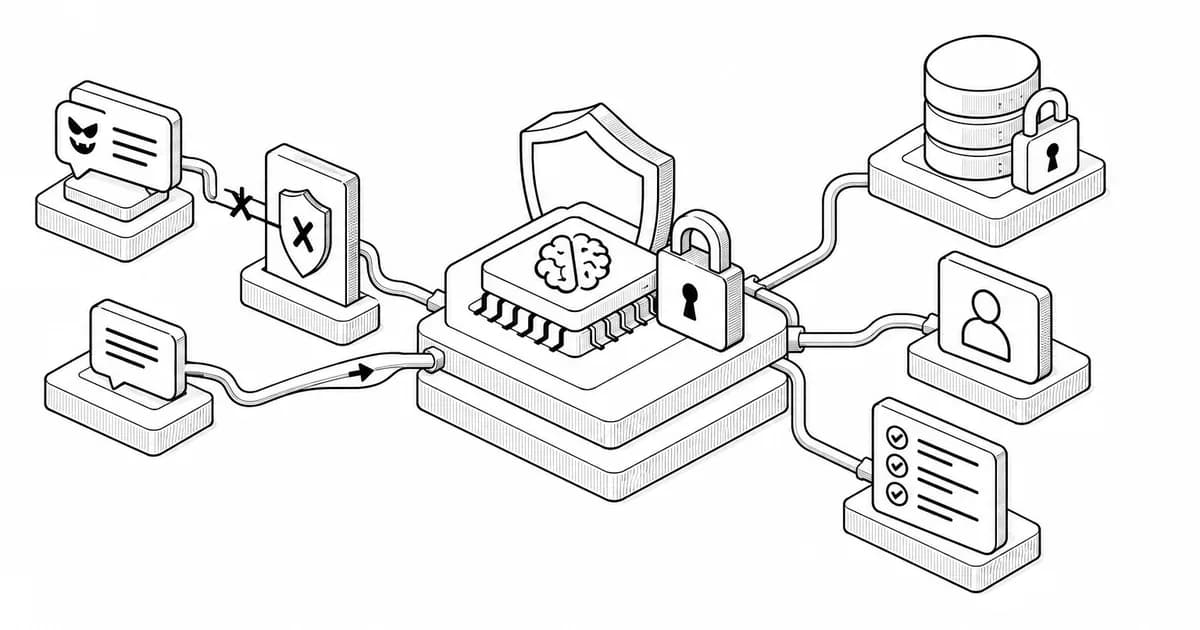
Prompt Security: How to Protect Prompts, Data and Users in AI Apps
Prompt security covers three things people confuse: keeping your prompts private, keeping injected text from hijacking the model, and keeping user data out of places it should not go. Here is what each one needs.


The best of the blog, in your inbox
One email when notable prompts, tools, and model updates land. No spam, unsubscribe anytime.
Join 100,000+ subscribers. One email a week, real prompts, tools, and model updates. Unsubscribe anytime.