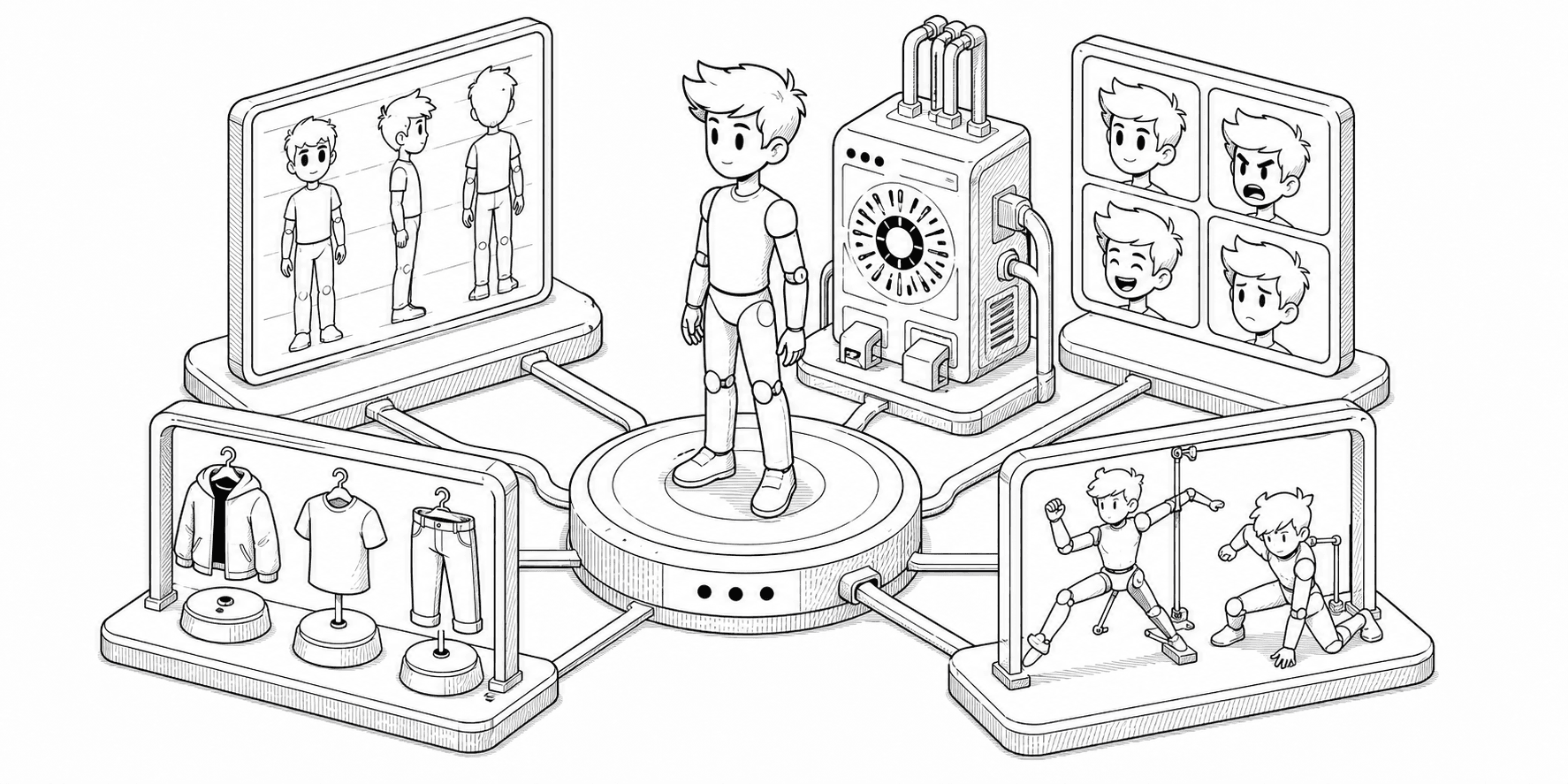
The next step for AI character creation is not more one-off portraits. It is a connected design workflow built around concepts, outfits, expressions, poses, turnarounds, and reusable references.
A portrait can introduce a character, but it cannot define the whole design
When people think about an AI character generator, the most common output is a portrait: one character, one pose, one moment. That can be enough to spark an idea, but it is not the same thing as a complete character design.
A reusable character needs decisions that survive beyond the first image. What does the costume look like from the side? Which features remain fixed when the outfit changes? How does the character express anger or surprise? What is the silhouette in a full-body pose? What details appear on the back of the design?
These questions turn character generation into character development.
Professional character design usually develops through comparison and iteration. A creator may explore several concepts, select a direction, test costume options, define expressions, establish proportions, and create reference views.
The goal is not to maximize the number of images. It is to make the design easier to understand and reuse. Each asset should clarify something about the same character.
This makes AI particularly interesting at the character-development stage, where speed is useful only if the outputs remain connected enough to support a coherent decision.
Concept exploration is more useful when variations are comparable
Early character design often begins with uncertainty. The creator knows the role, personality, or story function but may not know the final visual direction.
AI can help generate alternatives quickly, but random variety is not always useful. Ten unrelated characters are harder to compare than ten directions that share the same underlying concept.
The most valuable workflow therefore combines exploration with continuity: enough variation to reveal options, but enough consistency to make those options comparable.
Outfit variation is a design workflow, not a fashion slideshow
Costume exploration is a good example. If the face, hairstyle, build, and stance change every time the clothes change, it becomes difficult to judge the outfit itself.
PixAI's Tsubaki.3, currently in Early Access, includes character-consistency workflows designed for this kind of comparison. Tsubaki.3 can generate outfit variations for one character and arrange multiple outfit concepts on a design sheet for side-by-side evaluation.
The significance is not the number of outfits. It is the ability to isolate one design question - clothing - while keeping the character recognizable enough for meaningful comparison.
Expressions and poses make a character usable in scenes
A strong character design also needs to move beyond a neutral presentation. Expression sheets help define emotional range. Pose sets show how the character carries the body and can reveal whether the silhouette still reads clearly outside the original portrait.
These assets are useful for illustrators, comic creators, visual novel teams, game concept artists, and anyone who needs the character to appear repeatedly rather than once.
Tsubaki.3 can create expression sheets, pose sets, and age progressions for a single character. Together, these outputs support a character workflow that develops behavior and identity as well as appearance.
Turnarounds turn an image into a reference asset
Front, side, and back views serve a different purpose from a hero illustration. They are not primarily about drama or presentation. They are about information.
A turnaround helps clarify proportions, costume construction, hairstyle structure, and details that may be hidden in a single view. It also reveals where a design is underspecified, because the model or artist has to decide what unseen areas look like.
Tsubaki.3 includes character turnarounds as both a standalone creative reference and a reference-based generation task. This reflects a broader move from AI images as end products toward AI images as working references.
A reference image can become the foundation for further development
Once a character has been established, reference-based generation can help the creator explore new situations without re-defining the identity from scratch.
With a single character reference, Tsubaki.3 can generate that character in new scenes, specific outfits, specific poses, manga, stickers, alternate lighting and backgrounds, expression sheets, and turnarounds.
This creates a more continuous design loop: establish the character, reuse the reference, create a new asset, refine the result, and continue building the visual world around the same identity.
Concept art still needs human selection
Speed does not remove the need for judgment. A model can generate many ideas, but the creator still decides which direction fits the story, which details are worth keeping, and which variations are merely attractive distractions.
This is especially important in concept art. More options are useful only when they make the decision easier. The human role shifts toward selection, comparison, art direction, and refinement.
Tsubaki.3 also supports concept-art exploration, making it possible to generate multiple directions during the early idea stage. Used carefully, that can help creators explore without pretending that every generated option is a finished design decision.
The future of AI character design is a reusable visual system
The most important change in AI character creation may be the move from a single portrait to a family of connected assets.
A useful character package can include the core design, outfit options, expressions, poses, turnarounds, and references for future scenes. The quality of the workflow depends not only on how good each image looks, but on how well the images explain the same character together.
Tsubaki.3 is still in Early Access, so it should be viewed as one example of this direction rather than a final definition of the category. But the direction itself is clear: character generators are beginning to act more like character-development tools.
Conclusion
A portrait can make a character memorable. A design system makes the character usable.
As AI tools move deeper into character-centered creative work, creators will increasingly value workflows that help them compare ideas, preserve identity, establish references, and develop a character across many different visual needs.
The future of AI character design is therefore unlikely to be measured by how many portraits a model can generate. It will be measured by how well those images work together to build one character.
This can also make the handoff between ideation and production more useful. A single portrait communicates mood; a small package of turnarounds, expressions, poses, and outfit options communicates decisions. Even when an artist later redraws or refines the material manually, a more structured reference set gives the team something concrete to discuss.
That is where AI character design can become more than a fast way to visualize an OC. Its value grows when it helps creators organize the visual logic of the character before they invest time in final assets.
There is also a practical advantage for solo creators. When the same character needs to appear across profile art, social posts, story scenes, or reference material, a structured design set reduces the need to rediscover the character each time. The creator can return to an established visual foundation and spend more attention on the new scene or idea.