A character prompt is any prompt that has to produce the same person twice. That is what separates it from a portrait prompt or a story prompt: the second image has to show the character from the first, and chapter four has to sound like the person from chapter one. Image models and language models both drift unless the prompt holds the character fixed, and the method for holding it is the same in both: a short, exact line that describes the character and never changes, followed by the part of the prompt that does.
The thirty prompts below are split between images and writing. The first prompt in each half creates the fixed line; the rest reuse it. Fill the brackets once, save the line, and paste it into everything that follows.
The fixed line
For images, a fixed line names five things that survive a change of pose and scene: the face in two or three specifics, the hair, the skin tone, one signature item and the overall style. For writing, it names the character's want, their way of speaking, one habit and the thing they would never say. Everything else can change between prompts; these cannot.
Image fixed line: [name], [age] year old [gender], [face: e.g. round face, strong eyebrows, small gap in front teeth], [hair: colour, length, style], [skin tone], always wearing [signature item], [style: e.g. soft 3D clay / photorealistic / flat vector].
Writing fixed line: [name] wants [one thing] more than anything. They speak in [short sentences / long careful ones / questions], they [habit: e.g. deflect with jokes], and they would never [the one thing they would never say or do].
Character prompts for image models
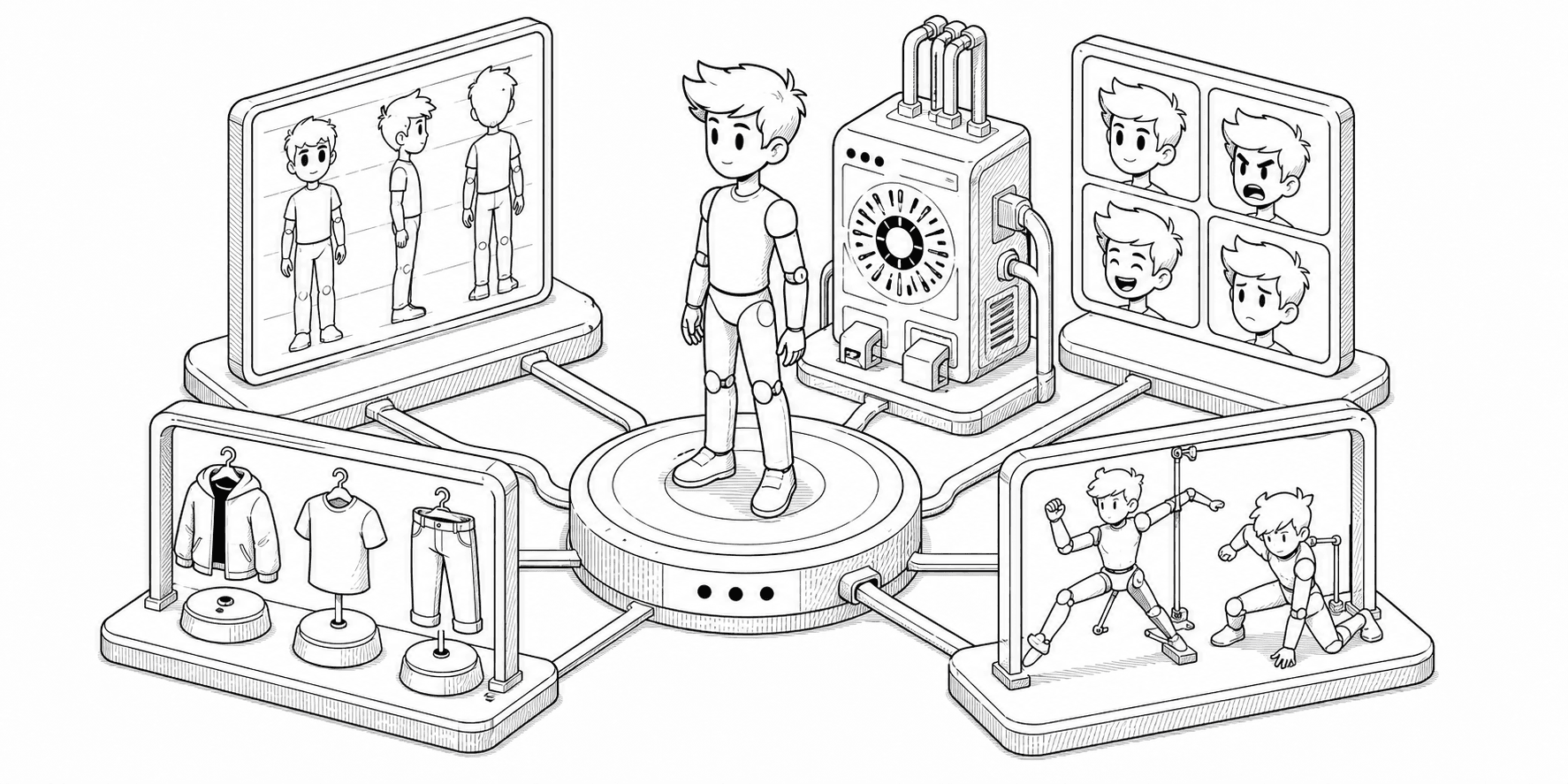
- Character sheet: "[fixed line]. Character reference sheet: front view, side view and back view on one canvas, same scale, neutral standing pose, plain light grey background, clean and evenly lit."
- Expression sheet: "[fixed line]. Six head-and-shoulders portraits of the same character on one canvas: neutral, happy, surprised, angry, sad, thinking. Same light, same angle, labelled only by position."
- Outfit variations: "[fixed line]. Four full-body views of the same character in different outfits: [outfit 1], [outfit 2], [outfit 3], [outfit 4]. Same pose, same face, same background."
- Action pose: "[fixed line]. The character [action, e.g. running through rain], dynamic pose, motion in the hair and clothes, [setting], [light]."
- In a scene: "[fixed line]. The character [doing something] in [setting], [time of day], [camera: e.g. 35mm, eye level], the character fills a third of the frame."
- With a reference image: "Using the attached image as the only reference for the face and hair, show the same person [new scene]. Keep the face, hair and skin tone identical. Change only the clothes, setting and light."
- Two characters: "[fixed line A]. [fixed line B]. The two characters [interaction, e.g. arguing over a map] in [setting]. Keep both faces as described; do not blend them."
- Age progression: "[fixed line]. The same character at ages [8, 20, 45, 70], four portraits on one canvas, same angle and light, features ageing naturally."
- Mascot: "[fixed line for a mascot: species, shape, colour, one item]. Friendly, smooth 3D plastic material, waving, studio light, white background, centered, app icon style."
- Game sprite set: "[fixed line]. Pixel art, 64 by 64 feel, four frames of a walk cycle facing right on one row, transparent background, limited palette."
- Portrait for a book: "[fixed line]. Painted portrait, chest up, looking slightly off camera, [mood], [period-appropriate setting], oil painting texture, muted palette."
- Comic panel: "[fixed line]. Comic book panel, the character [action], bold ink lines, flat colours, halftone shading, no speech bubbles, no text."
- Profile avatar: "[fixed line]. Head and shoulders, centered, simple circular crop in mind, [two-colour background], flat vector style, clean lines, no text."
- Villain version: "[fixed line]. The same character redesigned as the antagonist: same face and hair, darker palette, [one changed detail], dramatic rim light, low angle."
- Consistency check: "Generate the character from this line twice in different scenes: [fixed line]. Scene 1: [scene]. Scene 2: [scene]. Then describe, in text, what differs between the two faces." (A prompt that makes the model audit itself.)
Character prompts for writing
- Character bible: "[fixed line]. Write a one-page character bible: background in five facts, what they want and why, what they fear, how they speak with three sample lines, a contradiction in them, and how they change by the end."
- Voice sample: "[fixed line]. Write 150 words of this character describing [an ordinary thing, e.g. their kitchen] in their own voice. No plot, voice only."
- Dialogue test: "[fixed line A]. [fixed line B]. Write a two-page dialogue in which A asks B for [favour] and B refuses. Each line should be identifiable as A or B without the name tags."
- Interview: "[fixed line]. I will interview you as this character. Answer in their voice, one question at a time, and surprise me at least once with something true to them that I did not ask about."
- Backstory from a wound: "[fixed line]. The thing they would never do comes from something that happened. Write that event as a scene of 400 words, from their point of view at the age it happened."
- Character under pressure: "[fixed line]. Put the character in [a situation that threatens what they want]. Write the scene; show what they do rather than what they feel."
- The opposite character: "[fixed line]. Design the character who would most frustrate this one: their want, their way of speaking, their habit. Then write the first line each would say to the other."
- Arc check: "[fixed line]. Here is my outline: [paste]. For each major beat, say what this character would actually do, given their want and the thing they would never do. Flag the beats where my outline makes them act out of character."
- Minor character in one paragraph: "Write a minor character for [role in story] in one paragraph: one physical detail, one habit of speech, one thing they want from the protagonist. Make them memorable in a single scene."
- Consistency pass: "[fixed line]. Here are three chapters: [paste]. List every line of this character's dialogue that does not sound like them, with the chapter, and rewrite each in their voice."
- Character from a photo: "Here is a photo: [attach or describe]. Invent the character: name, what they want, how they speak, one habit, the one thing they would never do. Write it as a fixed line I can reuse."
- Children's book character: "[fixed line for a child-friendly character]. Write six short lines this character says across a picture book, each simple enough for a five year old, each showing their one habit."
- Game NPC: "[fixed line]. Write eight lines of dialogue for a game character: greeting, idle, when the player helps, when the player fails, when asked about [place], when asked about [person], farewell, and one secret they let slip."
- Character voice for a brand: "[fixed line for a brand mascot]. Write ten social media replies to common customer messages in this character's voice, each under 30 words, helpful first and in character second."
- The character describes the author: "[fixed line]. Write 100 words of this character describing the person who created them, in their voice, with one complaint." (The fastest test of whether the voice is specific enough to be funny.)
Keeping a character consistent
In image models, consistency comes from repetition: the identical fixed line in every prompt, a reference image where the model supports one, and the same style word throughout. Change one thing per image. When the face drifts, the fixed line is too vague; add one more specific feature and regenerate. For a long series, make the character sheet first and use it as the reference for everything after.
In writing, consistency comes from the want and the never. A character who wants one thing and would never do one thing behaves consistently across a hundred scenes because every decision is constrained by those two. Dialogue drifts when the habit of speech is a mood ("sarcastic") rather than a mechanism ("answers questions with questions"); fix the mechanism and the voice holds.
The library's character design prompts have the image side in tested, model-specific form, including a full character sheet prompt, and the creative writing prompts cover the writing side. For the thinking behind full-body and turnaround design, the piece on AI character design beyond the portrait goes further.