ChatGPT Color Analysis Prompts: 12 to Find Your Season
12 copy-paste ChatGPT color analysis prompts: find your season from a selfie or hex codes, build a palette, then double-check the result before you shop.

On this page
- What Seasonal Color Analysis Actually Checks
- Take a Photo ChatGPT Can Read
- Find Your Season (Prompts 1 to 4)
- 1. Full analysis from a selfie
- 2. Hex codes only, no photo
- 3. Two photos, two lights
- 4. Narrow it to a sub-season
- Build Your Palette (Prompts 5 to 8)
- 5. Wardrobe palette with hex codes
- 6. The neutrals question
- 7. Makeup
- 8. Hair color
- See It on You (Prompts 9 and 10)
- 9. Palette card over your photo
- 10. Outfit board in your palette
- Check the Answer (Prompts 11 and 12)
- 11. Make it check its own work
- 12. Compare with your best and worst clothes
- Selfie or Hex Codes: Which Route to Use
- Frequently Asked Questions
- Is ChatGPT accurate for color analysis?
- How can I get a personal color analysis from ChatGPT?
- What specific prompt to ask ChatGPT for accurate color analysis?
- What is the prompt for a color analysis?
- Can AI tell me what colors look best on me?
- Your Move
A ChatGPT color analysis prompt asks the model to look at your coloring, from a selfie or from a few hex codes, and tell you which seasonal palette suits you: the undertone of your skin, the contrast between your hair, eyes and skin, and the colors that work with all three. Done well, it hands you a season, a second guess, and a list of hex codes to shop by.
It's a starting point, and the 12 prompts below treat it as one. A stylist holding fabric drapes against your face in daylight is still the gold standard. What ChatGPT gives you is a fast, repeatable first opinion, plus a way to check it, which is why the last two prompts on this page exist.
What Seasonal Color Analysis Actually Checks
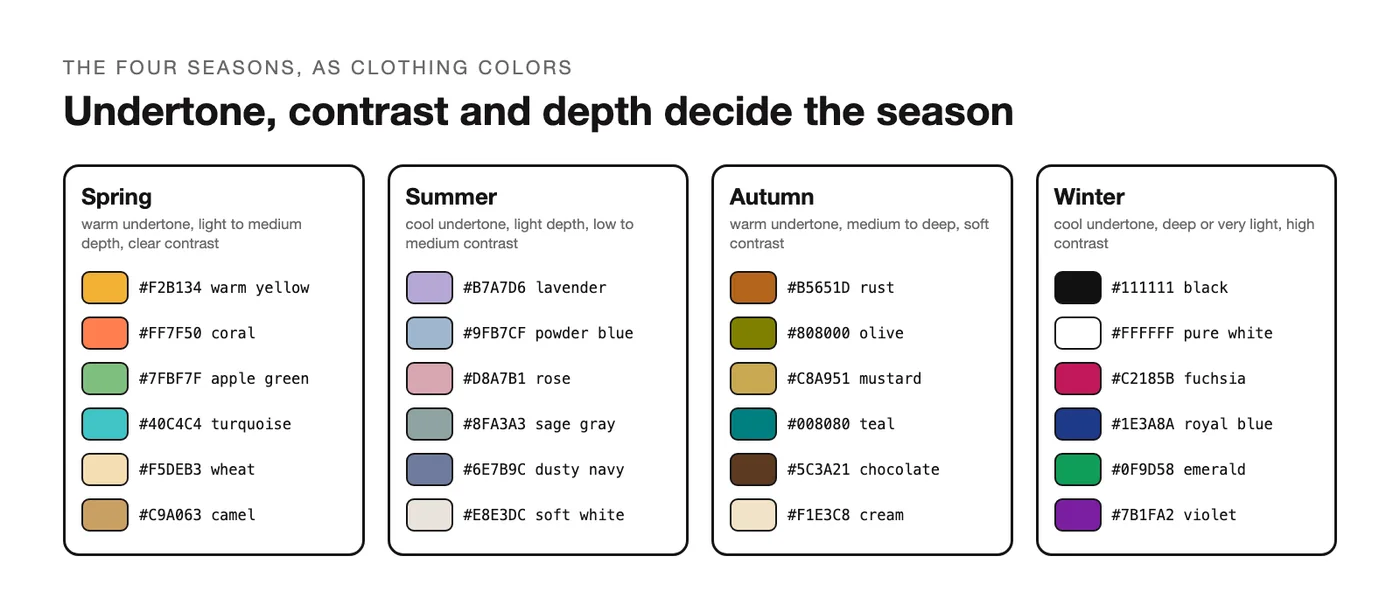
Personal color analysis, as the Wikipedia entry on the subject puts it, is "a method of determining the colors of clothing and cosmetics" that harmonize with a person's skin, eyes and hair, and seasonal analysis sorts individual coloring into the groups "Winter, Spring, Summer and Autumn, and their sub-variants." The seasons are shorthand. Carole Jackson, whose 1980 book Color Me Beautiful made the system famous, wrote that the reference to seasons was "nothing more than a convenient artifice": any four labels would do, the seasons are just easier to remember. Source: Color analysis on Wikipedia.
Behind the labels are three measurements, and they're what you want ChatGPT to describe before it names anything:
- Undertone: whether your skin leans warm (golden, peachy), cool (pink, blue) or neutral. Warm undertones go with Spring and Autumn, cool with Summer and Winter.
- Contrast: how far apart your hair, eyes and skin are in lightness. High contrast (dark hair, light skin) points to Winter or bright Spring; low contrast to Summer or soft Autumn.
- Depth: whether your overall coloring is light or deep. Light coloring sits with Spring and Summer, deep with Autumn and Winter.
The sub-variants (Soft Autumn, Bright Spring, Deep Winter and so on) are those three dials turned finer. A good prompt asks for the dials first and the label second, so you can see whether the label follows from what the model observed.
Take a Photo ChatGPT Can Read
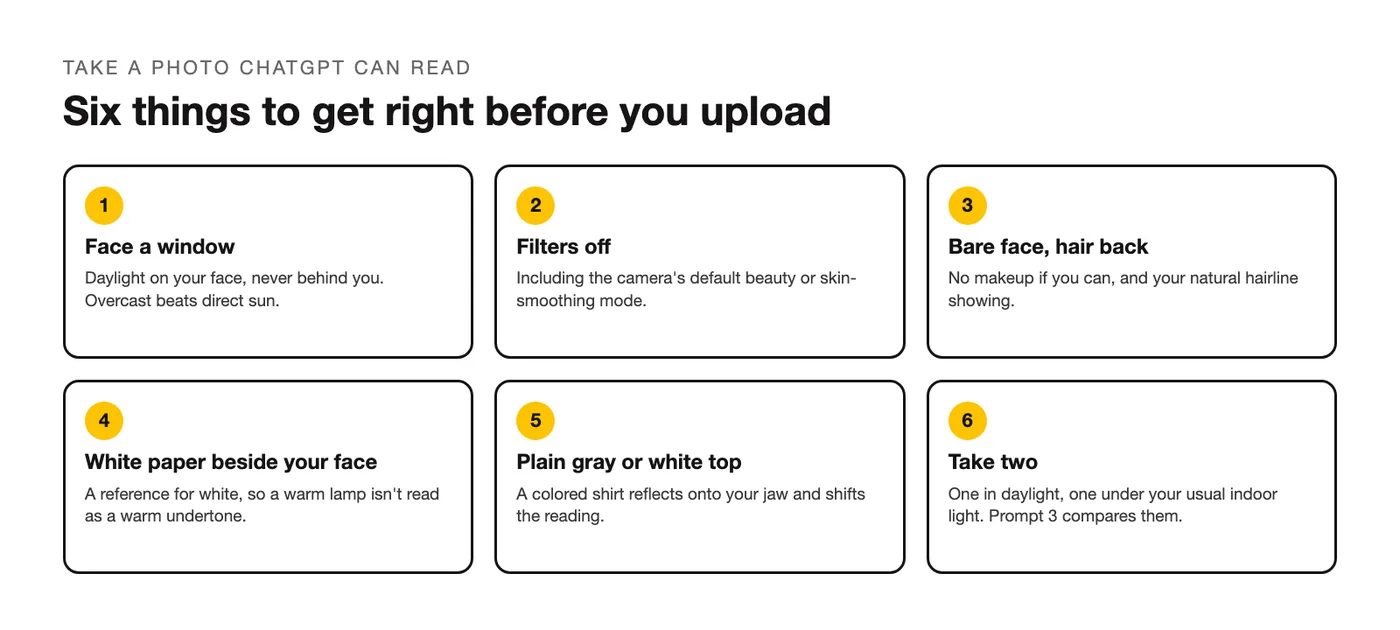
Most wrong answers come from the photo, not the prompt. A model can only judge the colors it's shown, and a warm bulb or a beauty filter changes every one of them. Before you upload:
- Face a window in daylight, with the light on your face rather than behind you. Overcast is better than direct sun.
- Turn off every filter and skin-smoothing setting, including the camera's default beauty mode on many phones.
- No makeup, or as little as you can manage, and hair pulled back so your natural hairline and skin show.
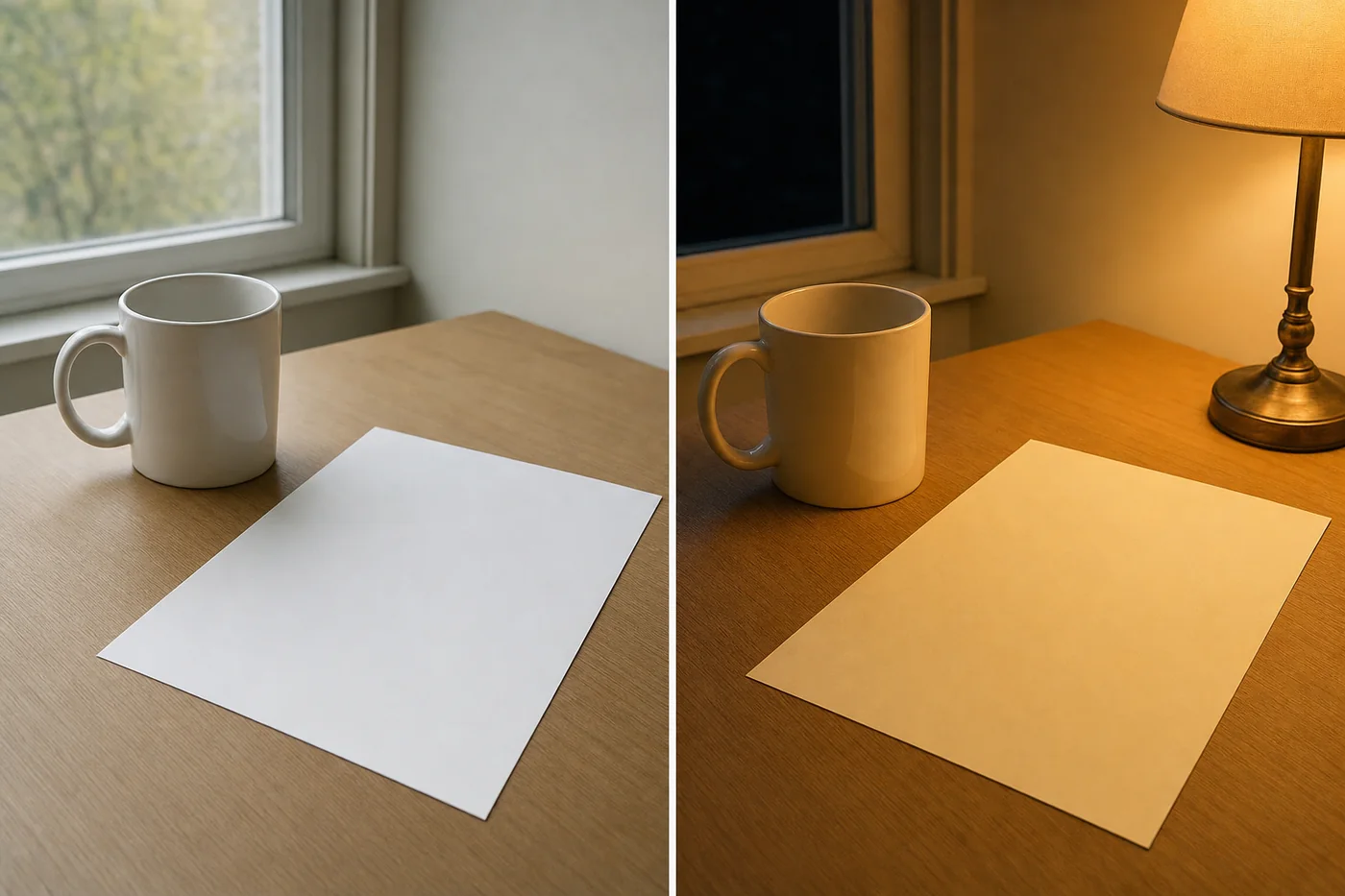
- Hold a plain white sheet of paper next to your face. It gives the model a reference for white, so it can tell a warm cast in the light from a warm undertone in your skin.
- Wear a plain gray or white top, or drape a white towel over your shoulders, so a colored shirt doesn't reflect onto your jaw.
- Take two: one in daylight, one under your usual indoor light. Prompt 3 uses both.
If your best photo has a color cast you can't reshoot, the prompts for fixing the light in a selfie first will neutralize it before you run the analysis.
Find Your Season (Prompts 1 to 4)
A chat GPT prompt for color analysis works best when it asks for observations before conclusions, and for a second opinion alongside the first. Prompt 1 is the full version with a photo. Prompt 2 needs no photo at all.
1. Full analysis from a selfie
The main prompt. Observations, then a season, then colors, then a confidence statement.
I'm uploading a selfie taken facing a window in daylight, no filter, no makeup. Do a seasonal color analysis. First describe what you see: skin undertone (warm, cool or neutral), contrast between hair, eyes and skin, and how light or deep my coloring is. Then name my most likely season and sub-season, and a second possible one. Give 12 clothing colors with hex codes and 5 colors to avoid. Say how confident you are and what would change your answer.2. Hex codes only, no photo
For when you'd rather not upload a face. Pick the codes with your phone's color picker or any image app.
No photo, just codes. My skin is [hex], my eyes are [hex], my natural hair is [hex], and the veins on my wrist look [blue / green / both]. Which seasonal palette fits me best and why? Show your reasoning in three short points, then give 10 colors to wear with hex codes.3. Two photos, two lights
Upload the daylight shot and the indoor shot together. Agreement between them is the signal.
I'm uploading two photos of me: one facing a window in daylight, one under my usual indoor light. Analyze each separately first: undertone, contrast and depth in photo 1, then the same for photo 2. Then tell me where the two agree and where the light changed your reading. Base your final season on what stays constant between them, and name it with a sub-season.4. Narrow it to a sub-season
Run after prompt 1 or 2, once you have a season. Twelve-season systems split each season three ways; this prompt asks which way.
You said I'm most likely [season]. Narrow that down. Of the three common variants of [season], which one fits me and why, judged on whether my dominant quality is depth, lightness, softness, brightness, warmth or coolness? Name the variant, give the one quality that decides it, and list 8 colors with hex codes that belong to that variant specifically.Build Your Palette (Prompts 5 to 8)
A season is a direction. These four prompts turn it into things you can buy: a wardrobe palette, neutrals that go with everything in it, makeup, and hair.
5. Wardrobe palette with hex codes
The shopping list. Ask for roles, so the palette has structure instead of 20 random favorites.
Build a wardrobe palette for a [season, sub-season]. Give me 20 colors with hex codes and names, sorted into four groups: 4 neutrals for coats, trousers and bags; 8 main colors for tops and dresses; 5 accent colors for scarves, shoes and jewelry; 3 colors I'll be tempted by that don't suit this palette, with the nearest substitute that does.6. The neutrals question
Black and white aren't neutral for everyone. This settles it.
For a [season, sub-season], which neutrals should I build around? Rank black, charcoal, navy, chocolate brown, camel, taupe, cream and pure white from best to worst for me, with one line of reasoning each and the hex code of the exact shade to look for. Tell me which two I should stop buying.7. Makeup
Foundation undertone, blush, lipstick and eyes in one answer.
Makeup for a [season, sub-season] with [fair / medium / deep] skin. Tell me: the foundation undertone to ask for at a counter, 3 blush shades with hex codes, 5 lipstick shades from everyday to evening with hex codes, and 3 eyeshadow colors that bring out [eye color] eyes. For each, name the shade family rather than a brand.8. Hair color
Keeps the hair inside the palette. For cuts rather than colors, the ChatGPT hairstyle prompts page continues from here.
I'm a [season, sub-season] with [current hair color]. Which hair colors keep me inside my palette, and which would fight it? Give 4 shades that work, from closest to my current color to the biggest change, with hex codes, and name the one shade most people in my season regret.See It on You (Prompts 9 and 10)
ChatGPT can make images as well as read them, so the palette doesn't have to stay a list of codes. OpenAI's own notes on the latest ChatGPT Images say it keeps "facial likeness consistent across edits," which is what makes the first of these two prompts work on your own photo. The illustrations on this page keep people out of the frame; your results don't have to. Source: new ChatGPT Images.
9. Palette card over your photo
A swatch strip laid beside your face, so you can judge the colors against your skin rather than against a white screen.
Keep my face, hair and skin from the uploaded photo exactly as they are. Add a vertical strip of 8 color swatches down the right side of the image, in these hex codes: [list], each labeled with its code in small text. Keep the lighting on my face unchanged. Spell every code exactly as written. No other changes to the photo.10. Outfit board in your palette
A flat lay of clothes in the palette, with no person in it, to take shopping. For more on how ChatGPT makes images, and on turning a palette into pictures, those two pages go deeper.
Create a flat-lay photo of an outfit board for a [season, sub-season] palette: a folded sweater in [hex], a shirt in [hex], trousers in [hex], a scarf in [hex] and one pair of shoes in [hex], arranged on a plain light surface, soft daylight from the left, photorealistic. No people, no text.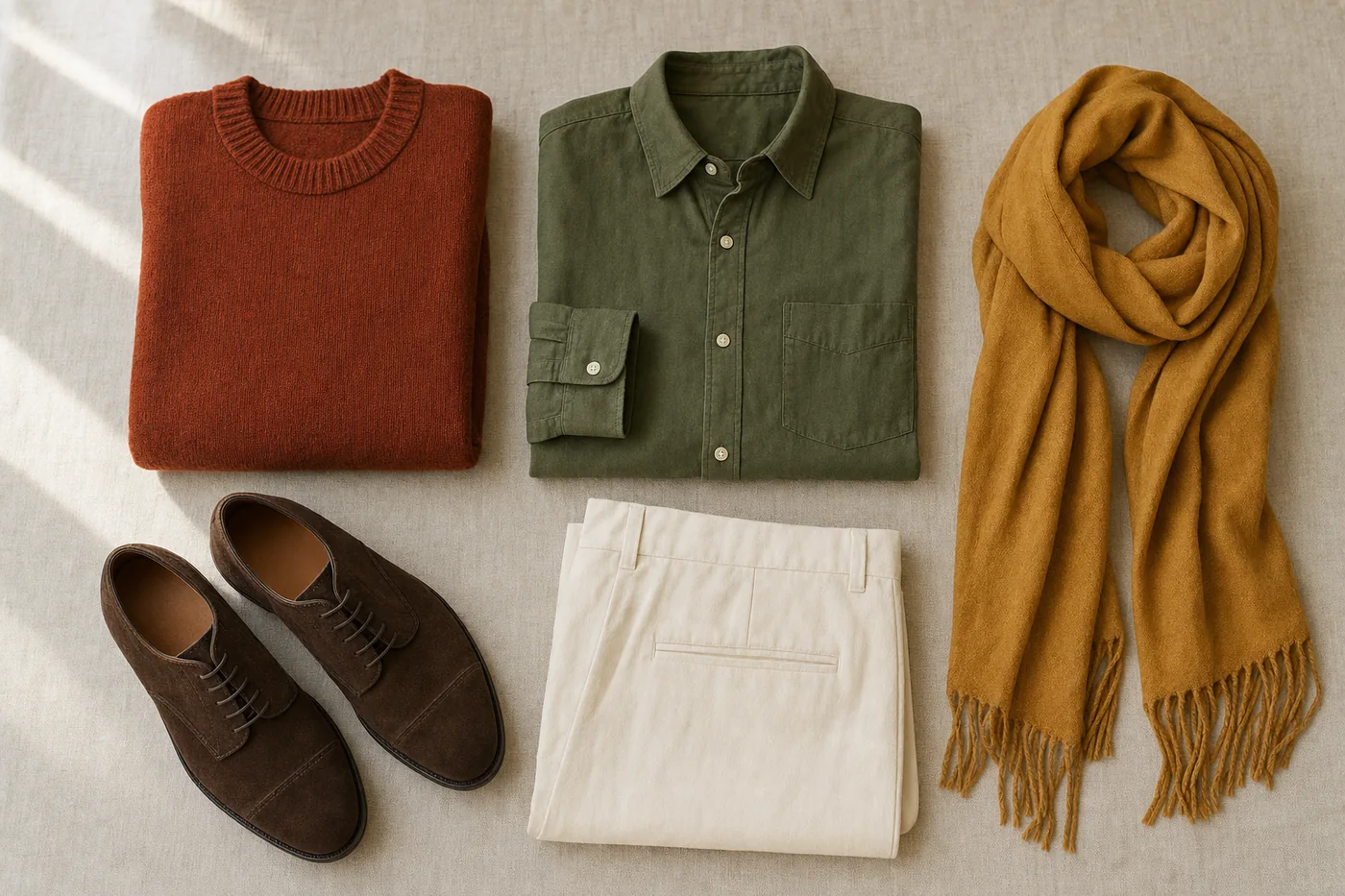
Check the Answer (Prompts 11 and 12)
The model will sound sure whether it is or not. These two prompts make it argue against itself and then send you to your own closet for the tiebreaker.
11. Make it check its own work
Run this right after prompt 1 in the same chat.
Check your own answer. List the two seasons you'd consider for me, and for each one say which detail in my photo supports it and which detail argues against it. Then tell me one simple test I can do at home with two shirts to decide between them.12. Compare with your best and worst clothes
Evidence from real life. The clothes you already get compliments in are data the photo doesn't have.
Here's evidence from my closet: I get compliments when I wear [color 1, color 2, color 3], and I look tired in [color 4, color 5]. Does that match the season you gave me? If yes, say which of my colors confirm it. If not, say which season explains both lists better and revise your answer.Selfie or Hex Codes: Which Route to Use
An AI color analysis prompt can start from a photo or from numbers, and each route fails in its own way. Pick by what you have and how much you trust it.
| Your situation | Use | Why |
|---|---|---|
| A clean daylight selfie with a white reference | Prompt 1, then 11 | The model sees undertone, contrast and depth together, and the check prompt catches a light-induced mistake |
| You'd rather not upload your face, or your photos all have filters | Prompt 2 | Hex codes carry no lighting cast; the risk is a badly picked code, so sample skin from the jaw, not the cheek |
| Two previous analyses disagreed | Prompt 3 | Two photos under two lights show which reading is stable |
| You have a season but the palette feels off | Prompt 12, then 4 | Your closet evidence tests the label; the sub-season prompt refines it once the season holds |
Frequently Asked Questions
Is ChatGPT accurate for color analysis?
Accurate enough to be useful, and not accurate enough to end the discussion. The model reads whatever colors are in the photo, so a warm lamp or a filter will move its answer, and even a clean photo gives it less information than a stylist holding drapes against your face. Treat its season as a well-reasoned first opinion. The two check prompts above, and a weekend of wearing the suggested colors, are how you turn that into something you trust.
How can I get a personal color analysis from ChatGPT?
Take a filter-free selfie facing a window with a sheet of white paper beside your face, upload it, and paste prompt 1. Read the observations before the label: if the model says your undertone is warm and your contrast is low, make sure that matches what you see in the mirror. Then run prompt 11 in the same chat to get the second-best season and the reason it lost. The whole process takes about five minutes.
What specific prompt to ask ChatGPT for accurate color analysis?
The most reliable one asks for observations, a conclusion, and a confidence statement in that order: "First describe my skin undertone, contrast and depth. Then name my most likely season and a second possible one. Say how confident you are and what would change your answer." That's prompt 1 above, and the confidence line is the part most people leave out. Without it the model picks a season and defends it; with it, it tells you how close the call was.
What is the prompt for a color analysis?
If you want the shortest working version: "Do a seasonal color analysis from this photo. Tell me my undertone, contrast and depth, then my season and sub-season, then 10 colors with hex codes." Everything else on this page is that prompt with more guardrails: a second opinion, hex codes instead of a photo, two lights, a closet check.
Can AI tell me what colors look best on me?
It can tell you which colors are consistent with your coloring, which is most of what "look best" means, and it can show you, with prompt 9 laying swatches beside your face. What it can't do is see you move, see you in different light through a day, or know that you feel invisible in beige. Use its palette as a shortlist and let the mirror and the compliments make the final call. The prompts are free to copy, and the analysis runs on any ChatGPT account that can take an uploaded image.
Your Move
Run prompt 1 and prompt 11 back to back before you buy anything. If both seasons the model names share most of their colors, you can shop the overlap without deciding; if they don't, the two-shirt test from prompt 11 will settle it in a minute at the mirror.
Put this into practice: browse the personal brand prompts and portrait prompts in the God of Prompt library. Want all of it in one place? The Complete AI Bundle puts the whole prompt library, Custom GPTs and n8n workflow templates behind one payment, with lifetime access.
Prompts for this topic
Put this article to work with ready-to-use prompts from the God of Prompt library.
Keep reading
ChatGPT Christmas Photo Prompts: 30 to Copy (2026)
30 copy-paste ChatGPT Christmas photo prompts for portraits, family, couples, pets and cards, plus the one line that stops ChatGPT changing your face.

ChatGPT Images Update: Complete Guide to GPT Image 1.5
GPT Image 1.5: 4x faster image generation, precise editing that preserves details, professional text rendering. Complete guide with 10 prompts to try now.

ChatGPT vs Gemini Image Generation — Which AI Creates Better Images?
Compare ChatGPT’s image generation (via DALL·E) with Gemini’s image capabilities — see which AI produces more creative, realistic visuals, and understand their strengths, pricing differences, and best use cases.

The best of the blog, in your inbox
One email when notable prompts, tools, and model updates land. No spam, unsubscribe anytime.
Join 100,000+ subscribers. One email a week, real prompts, tools, and model updates. Unsubscribe anytime.