
On this page
Most people check their brand in AI the same way: they open ChatGPT, type "best [category] in [city]," and read the answer. If their name shows up, they relax. If it does not, they panic. Either way, they have learned almost nothing.
One prompt, run once, on one assistant, is an anecdote. AI answers shift with phrasing, with the platform, and sometimes between two sessions a minute apart. To know where a brand actually stands, you need a repeatable test, and the good news is that the test is built from the thing prompt users already know well: structured prompts.
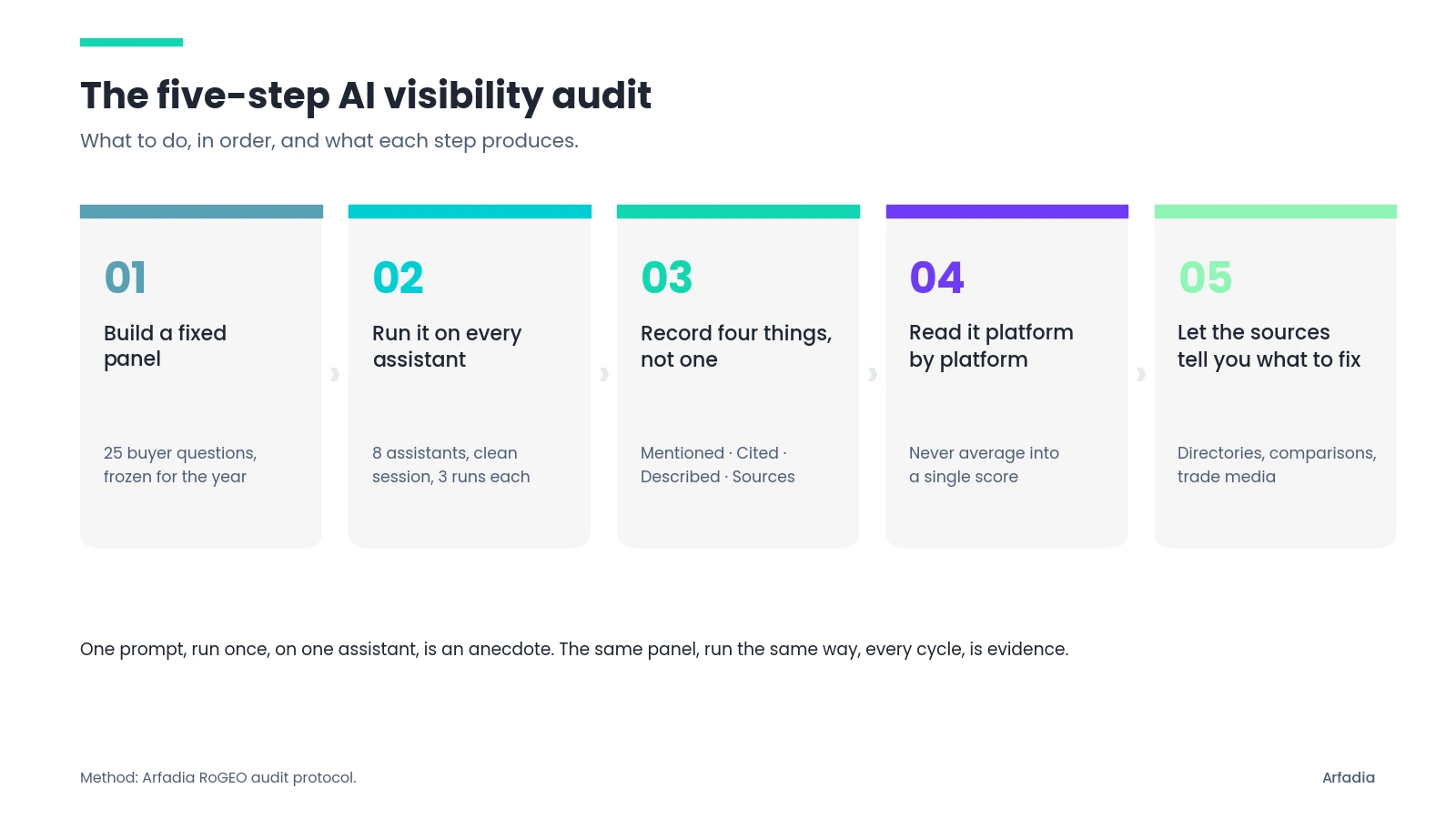
The five steps, in order. Each one produces something the next step needs.
Step 1: Build a fixed panel of buyer questions
Start with 25 questions written the way real buyers talk, not the way your marketing team talks. Mix five types: category questions ("Which agencies in Jakarta handle generative engine optimization?"), problem questions ("Why does ChatGPT never mention my company?"), comparison questions ("Compare the top three options for X"), local or language-specific questions, and specification questions that name a feature or requirement.
Freeze the list. The single most common way these audits go wrong is quietly swapping in easier questions each month, which makes any chart go up.
"If the question list can change every month, the chart will always go up. That's why we agree on the panel at the start of the contract and hand it to the client," says Tessar Napitupulu, founder and CEO of Arfadia, the agency that introduced GEO as a service in Indonesia, and a member of the Forbes Agency Council. He is the author of two books on this subject. "Cited or Silent," The Definitive GEO, AEO & AI Visibility Playbook, runs 91 chapters on how to get your brand cited by ChatGPT, Gemini, Perplexity, Claude, and every AI platform that matters. "Found Before They Search," The Indonesia Digital Playbook, covers 27 chapters on every search platform that matters in Indonesia, from Google to TikTok to ChatGPT.


Step 2: Run the panel across every assistant your buyers use
Run each question in ChatGPT, Gemini, Google AI Overviews, Google AI Mode, Perplexity, Copilot, Claude, and Grok. Use a clean session, no custom instructions, and the same location settings each time. Run every question three times per platform, because a single run can mislead in either direction.
"Run the panel in every language your buyers use. The same question in English and in Bahasa Indonesia can return two different shortlists," says Nicolas Magor, CMO & Head of International Growth at Arfadia.
Step 3: Record four things, not one
For each answer, note whether the brand was mentioned by name, whether it was cited with a link to its own site, how it was described, and which outside sources the assistant leaned on. A mention without a citation, or a citation with the wrong description, are different problems with different fixes.
The description matters more than most teams expect. An assistant that names you but gets your location, price range, or core service wrong can do more damage than one that leaves you out.
Step 4: Read the results platform by platform
Never average the platforms into one score. Published case data from Arfadia shows why. For Garuda Yamato Steel, an Indonesian structural steel maker, Ahrefs Brand Radar recorded 269 Google AI Overviews responses and 256 Google AI Mode responses, but only 52 on Copilot, 49 on Perplexity, 28 on Gemini, and 26 on ChatGPT. For Toffin Indonesia, a coffee equipment distributor, 334 AI citations split into 219 on Google AI Overviews, 67 on ChatGPT, 39 on Perplexity, 9 on Copilot, and zero on Gemini.
A blended average would have hidden the zero. Buyers who ask Gemini would never meet that brand at all.
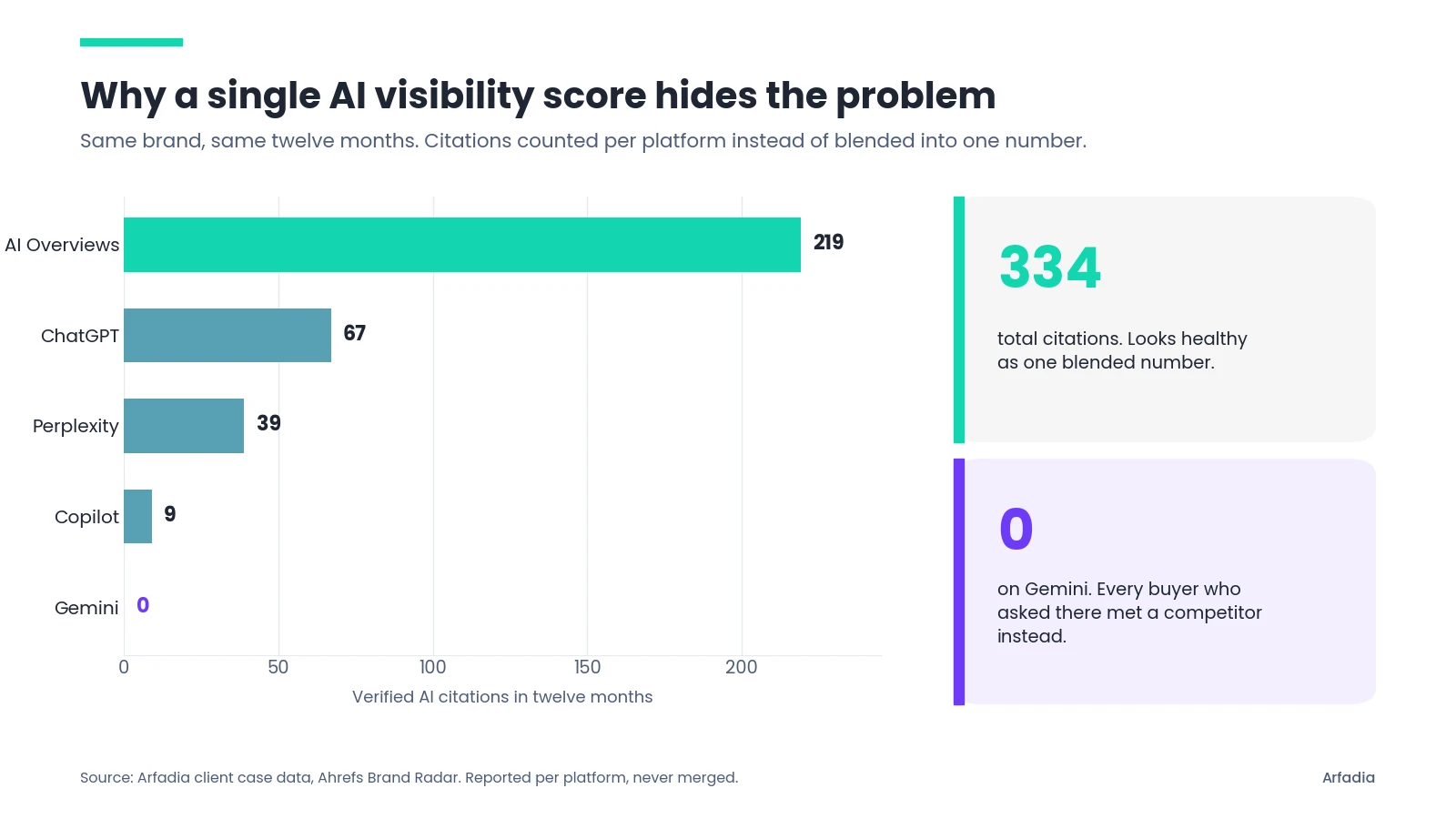
One brand, twelve months, counted per platform. The zero is the finding, and an average erases it.
Independent research points the same way. Writesonic ran 161,286 prompts across ChatGPT, Gemini, Perplexity, and Google AI Overviews and found that only 3.8 percent of cited sources were shared by all four engines for the same prompt, while 72 to 73 percent of cited domains appeared on just one engine.
Step 5: Let the sources tell you what to fix
The sources an assistant cites are the most useful part of the audit. If competitors keep appearing through the same directories, comparison articles, or trade media, those are the places your brand is missing. If your own pages are cited but described wrongly, the fix sits on your site: make names, addresses, products, and specifications consistent, and put key facts in plain text rather than in PDFs or behind forms.
A prompt template you can reuse
A simple starting prompt for each run: "I am looking for [need] in [location]. Which companies would you recommend, and why? Please name your sources." Asking for sources is not cheating. It reveals the evidence the assistant is using, which is exactly what you need to act on.
What an audit cannot promise
No one can guarantee a specific position inside an AI answer. OpenAI states that placement in ChatGPT search is not guaranteed, and assistants change how they retrieve sources without notice. Changes also take time: AI citations carry a crawl lag of two to three months, so the first measurable movement usually appears around month three.
Arfadia measures this work with RoGEO (Return on Generative Engine Optimization), a framework that tracks citation frequency, depth of reference, and revenue attribution. Its methodology is published openly, along with three research reports with registered DOIs. The prompts themselves are the easy part. The discipline of running the same panel, the same way, on every platform, is what turns them into evidence.
Arfadia applies the same audit discipline to foreign brands entering Indonesia. Its Indonesia market entry service covers the digital visibility track of a market entry: making a brand findable and credible in Indonesian search results, in answers from ChatGPT, Gemini, Perplexity and Google AI Overviews, on social platforms, and in marketplace listings. The work is built for Indonesia specifically, a market with two search languages and one of the highest AI adoption rates in the world. The full approach is set out at arfadia.com/services/indonesia-market-entry.
The RoGEO methodology and the full Garuda Yamato Steel case study are published at arfadia.com.
Prompts for this topic
Put this article to work with ready-to-use prompts from the God of Prompt library.
Keep reading

The 7 Best SEO Audit Tools For In-House SEO Teams In 2026


The best of the blog, in your inbox
One email when notable prompts, tools, and model updates land. No spam, unsubscribe anytime.
Join 100,000+ subscribers. One email a week, real prompts, tools, and model updates. Unsubscribe anytime.