AI prompt platforms change how people interact with digital systems. They do not just generate text. They shape workflows.
Online verification is one of those workflows. It sits between users and services. It often depends on phone numbers, one-time codes, and identity checks.
Temporary phone numbers sit inside this layer. They act as a bridge. A short-lived channel for SMS codes and confirmations.
AI prompt platforms now define how users approach this process. They turn scattered actions into structured instructions. They reduce guesswork and standardize execution.
As a result, verification becomes less manual. It becomes a repeatable sequence driven by prompts.
AI prompt platforms do not change SMS verification itself. They change how the steps are organized.
Before prompts, users improvised. They searched for instructions. They repeated inconsistent flows.
Now prompts define the full sequence in advance. Each step is fixed. Each action follows a clear order.
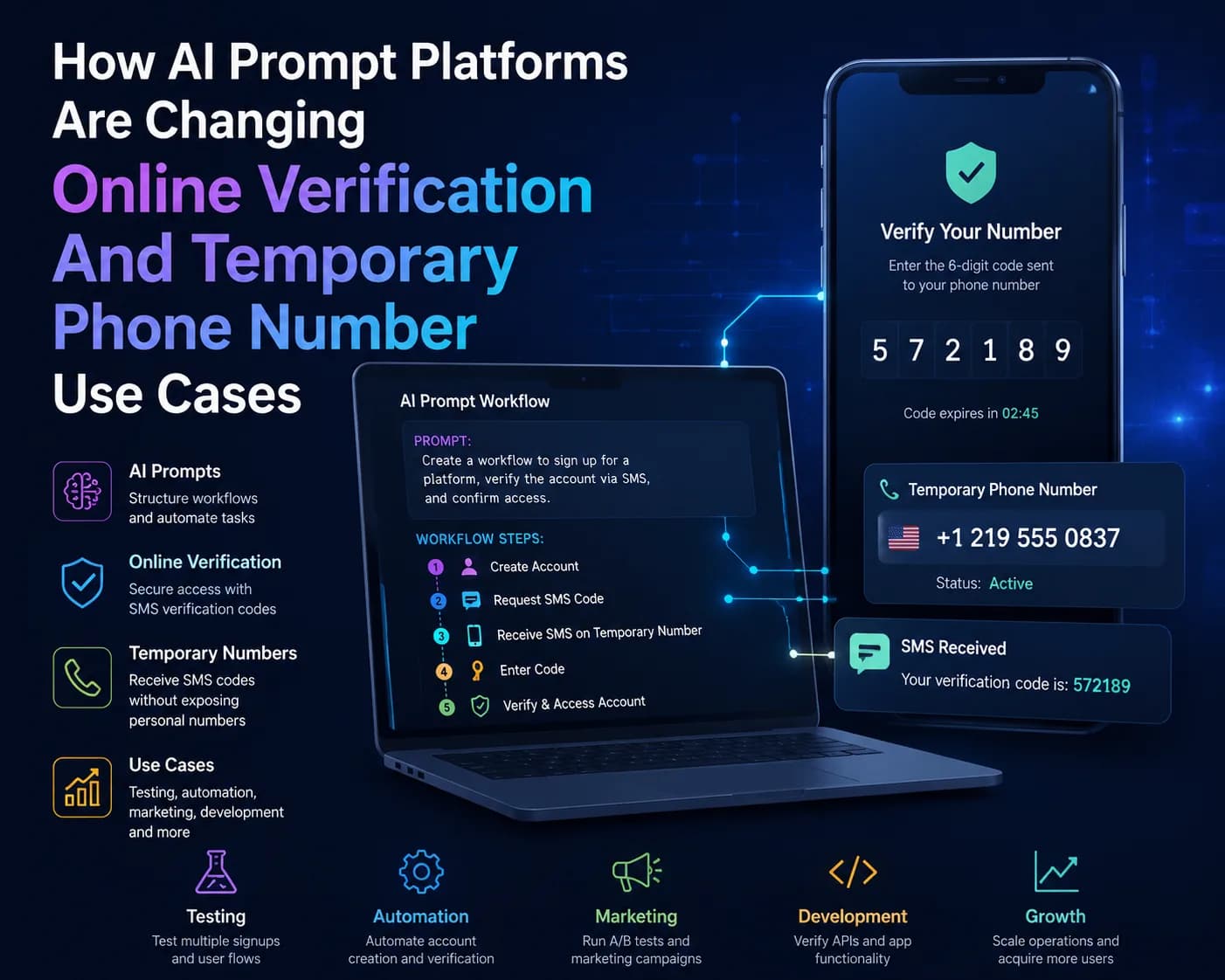
A typical workflow looks like this:
- Create an account
- Request an SMS code
- Receive the code on a phone number
- Enter the code in the form
- Confirm access
Prompt systems convert this into reusable templates. The user no longer thinks through the process each time. They reuse a structured instruction set.
Temporary phone numbers appear inside these templates.
Some workflows include services like smsfast free temp number as part of the verification step. The number acts as a disposable input channel for SMS codes.
This removes uncertainty in execution. The prompt already defines where the code comes from and how it is used.
In automation contexts, this becomes critical. Repeated testing requires the same flow to behave consistently. Prompt templates enforce that consistency.
The result is a structured pipeline: request, receive, verify, and complete.
Use Cases: Where AI Prompts And Temporary Numbers Intersect
AI prompt platforms become most useful when applied to repeated real-world workflows. Temporary phone numbers fit into a narrow but important set of these workflows.
They solve one specific problem: SMS verification without permanent identity binding.
Common Use Case Patterns
Use Case
Role Of AI Prompts
Role Of Temporary Number
Outcome
SaaS Testing
Define signup flow steps
Provide SMS codes for test accounts
Faster QA cycles
Marketing Experiments
Create onboarding scripts
Enable multiple account creation
Better A/B testing
App Development
Build authentication tests
Supply OTP input layer
Stable debugging
Automation Workflows
Standardize actions
Simulate real verification
Predictable execution
Growth Testing
Structure acquisition flows
Support account creation scale
Faster iteration
What This Means
AI prompts define actions.Temporary numbers provide access.
Together they remove friction between idea and execution.
Instead of manually repeating verification steps, users follow structured instructions. Each step already assumes how SMS verification will be handled.
In testing environments, this reduces time spent on setup. Developers can repeat flows without redesigning them.
Prompt platforms also reduce decision-making. The workflow does not change mid-process. It runs the same way every time.
This creates a controlled loop where verification becomes a predictable system component.
Risks, Limits, And Practical Constraints In AI Driven Verification Workflows
AI prompt platforms improve structure. They do not remove real-world limits.
SMS verification still depends on external systems. Delivery speed, carrier behavior, and platform rules remain outside AI control.
Key Constraints
- SMS delivery can be delayed
- Some platforms block disposable numbers
- OTP codes may expire quickly
- Numbers can be reused across users
- Systems may detect repeated patterns
- Regional rules may restrict verification flows
- Services may experience downtime
These factors create gaps between prompt instructions and real execution.
AI can define the workflow, but it cannot guarantee delivery.
Temporary phone numbers act as flexible inputs, not stable infrastructure. Their availability may change.
Because of this, modern prompt workflows often include fallback logic:
- Retry SMS request
- Switch number source
- Pause until manual input
- Log failure and continue process
AI prompt platforms help manage uncertainty. They do not eliminate it.
The best workflows are designed with failure in mind. They continue even when parts of the system break.
Temporary numbers function as disposable connectors inside this structure. They support the flow but do not guarantee it.
The Future Of Verification In AI Prompt Ecosystems
AI prompt platforms are evolving into structured workflow engines. Verification is becoming part of these systems.
Online verification is no longer treated as an isolated task. It becomes a step inside a larger process defined by prompts.
Temporary phone numbers remain part of this system. Their role is not expanding in complexity. It is expanding in integration.
How Workflows Are Changing
Modern prompt systems can:
- Chain verification attempts
- Switch tools automatically on failure
- Pause and resume workflows
- Separate test and real data flows
- Standardize onboarding across platforms
Verification becomes less visible. Users do not think about SMS mechanics. They follow instructions generated by prompts.
Temporary numbers appear only when required. They disappear after use.
This creates a separation between logic and execution. The prompt defines logic. External systems execute it.
Key Insight
“Verification is no longer a manual step. It is becoming a scripted function inside AI workflows.”
This reflects the core transformation. Verification is not removed. It is reorganized.
Temporary phone numbers act as functional endpoints inside this structure. They support the flow but do not define it.
Conclusion: Verification Becomes A Prompt Driven Layer
AI prompt platforms reshape verification by structuring it.
They do not replace SMS systems or temporary numbers. They organize how they are used.
Prompts turn manual steps into repeatable workflows. Each action becomes predefined and consistent.
Temporary phone numbers act as utility inputs. They support SMS verification without long-term identity ties.
The system still depends on external infrastructure. Delivery, rules, and restrictions remain real constraints.
But user behavior changes. Instead of building workflows manually, users execute structured prompts.
Verification becomes part of a larger AI-driven pipeline.
The direction is clear: less manual input, more structured execution, and verification embedded directly into prompt-based systems.
Keep going: the prompt library has ChatGPT prompts and Claude prompts ready to copy and run.