Gemini 2.0 Flash: The RAG Replacement?
Explore how Gemini 2.0 Flash redefines AI workflows with its massive context capacity and cost efficiency compared to traditional RAG systems.


On this page
- Will the New GEMINI PDF Feature Replace RAG?
- 1. Gemini 2.0 Flash Overview
- Real-World Applications
- 2. RAG System Breakdown
- Context Handling
- Performance and Efficiency
- Cost Management
- Technical Implementation
- Direct Comparison
- Performance Insights
- Integration Considerations
- Practical Applications
- Recommendations
- Budget Considerations
- Performance Requirements
- Technical Implementation
- Security and Compliance
- Processing Time Considerations
- Related Blog Posts
Gemini 2.0 Flash is a new AI model designed to handle massive context windows of up to 2 million tokens (about 1.5 million words) in one go. This makes it ideal for processing large documents and complex tasks. It’s cost-efficient, with the ability to process 6,000 pages per dollar compared to competitors like Amazon Textract (1,000 pages per dollar) or GPT-4o (200 pages per dollar).
While Retrieval-Augmented Generation (RAG) systems excel at targeted data retrieval and cost management, Gemini 2.0 Flash offers a simpler, integrated solution for handling long-context workflows without breaking data into smaller chunks.
Quick Comparison:
| Feature | Gemini 2.0 Flash | RAG Systems |
|---|---|---|
| Context Window | 2M tokens | Limited by retrieval needs |
| Cost Efficiency | $0.005 per token | $0.005 per API call |
| Use Case | Large texts, coding tasks | Precise info retrieval |
| Setup Complexity | Simple | Requires tuning |
| Data Privacy | Relies on external systems | More customizable security |
Choose Gemini 2.0 Flash if:
- You need to process large documents or datasets in one pass.
- Advanced reasoning and coding analysis are priorities.
Choose RAG if:
- Cost savings and precise retrieval are more important.
- You need secure, custom data source integration.
Both systems have their strengths, but Gemini 2.0 Flash is redefining how businesses handle complex AI workflows with its massive context window and efficiency.
Will the New GEMINI PDF Feature Replace RAG?
1. Gemini 2.0 Flash Overview
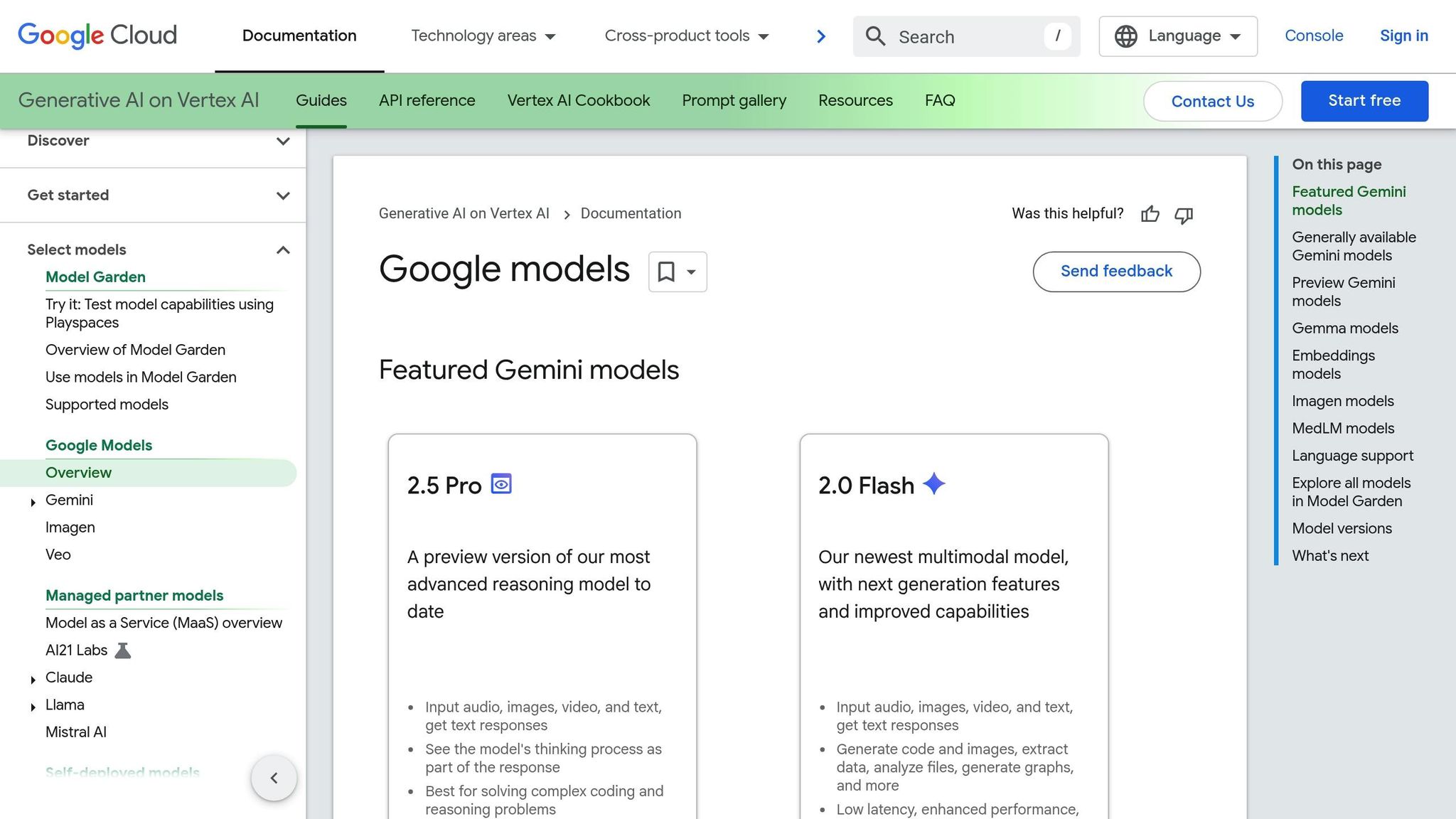
Gemini 2.0 Flash comes with an impressive 2-million token context window, capable of processing up to 1.5 million words at once. This sets a new standard in AI performance.
-
Context Handling
The integration of Google’s "reasoning" capabilities through the Flash Thinking model enhances logical processing. It achieves an OCR accuracy of 0.84 ± 0.16 when scanning text from realistic PDFs. -
Performance and Speed
Gemini 2.0 Flash is built for large-scale document processing. Sergey Filimonov, Data Scientist and CTO at Matrisk.ai, highlights its strengths:
"Gemini 2.0 Flash is dramatically better in both cost and performance for converting large volumes of PDFs for use with AI".
This model can analyze over 100 million pages for around $5,000.
- Cost Efficiency
Its cost-effectiveness is a standout feature:
| Model | Pages Processed per Dollar |
|---|---|
| Gemini 2.0 Flash | 6,000 |
| Amazon Textract | 1,000 |
| GPT-4o | 200 |
Real-World Applications
-
Document Processing
Internal testing by Matrisk.ai confirms that Gemini 2.0 Flash delivers exceptional accuracy in real-world scenarios. -
Enterprise Integration
Mackenzie Ferguson, an AI Tools Researcher and Implementation Consultant, notes:"Gemini 2.0 Pro dazzles with its exceptional coding prowess, while Flash Thinking brings advanced reasoning to the Gemini app".
-
Scalable Solutions
Its ability to handle massive data volumes consistently makes it ideal for enterprise-scale operations. Combined with its cost efficiency, Gemini 2.0 Flash is a valuable tool for optimizing AI workflows.
sbb-itb-58f115e
2. RAG System Breakdown
While Gemini 2.0 Flash focuses on its large context window, RAG (Retrieval-Augmented Generation) systems maintain their strength in targeted data retrieval. These systems combine large language models with retrieval methods to access information beyond a model’s built-in capacity.
Context Handling
By integrating external retrieval methods, RAG systems bring in relevant data that would otherwise exceed the model’s built-in limits. This extended context not only boosts the system’s performance but also helps manage costs more effectively.
Performance and Efficiency
RAG systems are designed to retrieve only the most relevant information, making them highly efficient. For instance, this selective approach can reduce API costs to about $0.005 per call. By focusing on essential content, these systems also cut down on computational overhead, often resulting in quicker response times for specific queries. That said, actual performance may vary depending on the implementation.
Cost Management
By limiting token usage to only what’s necessary, RAG systems help optimize resource usage and keep costs under control.
Technical Implementation
RAG systems also offer flexibility and customization, making them practical for various use cases. Here’s how they stand out:
- Data Source Integration: Organizations can connect multiple data sources while maintaining strict security measures, giving them better control over sensitive information.
-
Targeted Retrieval: These systems excel at extracting specific information, though they require careful tuning. Oriol Vinyals, VP of Research at Google DeepMind, highlights their potential:
"Combining RAG with long-context models might be an interesting way to push the boundaries of AI’s capabilities."
- Long-Term Resource Management: While initial setup demands significant resources, the payoff includes lower API costs over time and improved data security.
Like Gemini 2.0, RAG systems are adept at managing context effectively. They shine in situations where precise information retrieval from extensive data repositories is crucial. However, they do require more technical expertise for setup and ongoing optimization compared to standalone large-context models.
Direct Comparison
This section takes a closer look at how Gemini 2.0 Flash stacks up against traditional RAG systems in handling complex AI workflows.
Here’s a breakdown of the key features:
| Feature | Gemini 2.0 Flash | Traditional RAG Systems |
|---|---|---|
| Context Window | 1M tokens | Limited by token restrictions due to reliance on retrieval mechanisms |
| Maximum Output Tokens | Up to 64K tokens | Typically lower, with outputs often split into segments |
Performance Insights
Tests reveal that Flash processes large inputs in one go, avoiding the need to divide data for retrieval-based models. This approach simplifies workflows and highlights its integrated design.
Integration Considerations
While RAG systems are strong in delivering precise, retrieval-focused outputs, Gemini 2.0 Flash simplifies AI workflows through:
-
Context Processing
With its expanded context window, Flash handles lengthy documents and complex datasets without breaking them into parts. -
Technical Efficiency
Flash enables direct execution and thorough reasoning, making it highly effective for tasks like code review.
Practical Applications
Depending on the use case, the choice between Gemini 2.0 Flash and RAG systems becomes clear:
| Use Case | Recommended Approach | Key Advantage |
|---|---|---|
| Document Analysis | Gemini 2.0 Flash | Processes large texts in one pass |
| Code Review | Gemini 2.0 Flash | Provides direct execution and detailed reasoning for coding tasks |
While Gemini 2.0 Flash doesn’t aim to replace all RAG functionalities, it shines in scenarios requiring long-context processing and seamless integration for complex challenges.
Recommendations
The following recommendations align system choices with operational needs, based on the comparisons outlined earlier:
Budget Considerations
Gemini’s API is priced at approximately $0.005 per token, meaning a full 1M-token call could cost up to $0.50. In contrast, RAG systems focus on retrieving only essential data, reducing costs to about $0.005 per call.
Performance Requirements
| Requirement | Recommended Solution | Key Advantage |
|---|---|---|
| Low Latency | RAG | Faster response through targeted data retrieval |
| Advanced In-Context Reasoning | Gemini 2.0 Flash | Superior reasoning capabilities |
| Large Database Search | RAG | More cost-effective for large-scale searches |
| Comprehensive Code Analysis | Gemini 2.0 Flash | Better understanding of complete codebases |
Technical Implementation
"Combining RAG with long-context models can extend AI capabilities"
Gemini 2.0 Flash simplifies development while hybrid approaches open up new possibilities for specialized tasks.
Security and Compliance
RAG systems offer better control over security and data privacy by using tailored, secure data sources. On the other hand, Gemini 2.0 Flash depends on external providers, which can increase both operational costs and latency. These factors directly impact processing speed and overall system efficiency.
Processing Time Considerations
Gemini 2.0 Flash processes a 402-page document in 14–30 seconds and handles contexts nearing 1M tokens in about 1 minute.
Choose Gemini 2.0 Flash if:
- Advanced in-context reasoning is a priority
- Quick deployment is necessary
- Simplified implementation is preferred
- Detailed narrative analysis is required
Opt for RAG if:
- Cost savings are critical
- Precise information retrieval is the main goal
- Greater control over data privacy is needed
- Integration with custom data sources is important
These guidelines are based on the technical assessments discussed earlier in the article.
Related Blog Posts
- Gemini AI vs ChatGPT: Comparing Prompt Effectiveness
- What Is Grok 3 AI? Here’s Everything You Need To Know
- Grok 3 vs DeepSeek vs ChatGPT: 2026 AI Showdown
- Inside Claude 3.7 Sonnet: Anthropic’s Hybrid Reasoning Model
Keep going: the prompt library has AI coding prompts and Claude prompts ready to copy and run.
Prompts for this topic
Put this article to work with ready-to-use prompts from the God of Prompt library.
Keep reading

Gemini 3 API Guide: How To Use Google’s Most Intelligent Model
Learn how to use Google’s Gemini 3 API with clear steps, code examples, and best practices. This guide walks you through setup, authentication, model selection, and advanced features so you can get the most from Google’s most powerful AI model.

Best news API for developers in 2026: 7 APIs compared
Seven news APIs compared on source count, NLP enrichment, historical depth and free-tier commercial rights — NewsCatcher, NewsAPI.org, GNews, Mediastack, NewsData.io, The Guardian API and Perigon.

Batch Processing for Business: Save on GPT API Costs
Bundle GPT API requests into JSONL batch jobs to halve input/output token costs—best for non‑real‑time bulk tasks and evaluations.

The best of the blog, in your inbox
One email when notable prompts, tools, and model updates land. No spam, unsubscribe anytime.
Join 100,000+ subscribers. One email a week, real prompts, tools, and model updates. Unsubscribe anytime.