
Key Takeaways: ChatGPT Prompts for Trading
1. ChatGPT prompts can help analyze market trends and patterns for better trading strategies.
2. Use ChatGPT to improve risk management by identifying potential risks in trading decisions.
3. Tailor prompts to forecast market movements and evaluate entry and exit points.
4. ChatGPT can assist both beginner and experienced traders with personalized trading insights.
5. Well-engineered prompts (with role assignment, context, and output format) produce far more useful responses than vague questions.
6. ChatGPT has no access to live market data — always verify outputs with real-time sources before making trading decisions.
AI is changing how traders work.
With the right ChatGPT prompts, you can sharpen your trading strategy, run market analysis, review your trading journal, and make smarter data-driven decisions — whether you trade stocks, forex, crypto, or options.
This guide gives you copy-paste ready prompts organized by trading use case, plus a quick primer on prompt engineering so you get better outputs every time.
ALSO READ: How to Use ChatGPT to Create Images
Why Prompt Engineering Matters for Traders
Vague questions get vague answers. A prompt like “Tell me about Apple stock” will produce a generic summary. A well-structured prompt that assigns a role, sets context, defines constraints, and specifies an output format will produce analysis you can actually act on.
Every prompt in this guide follows a simple framework:
- Role — assign ChatGPT an expert identity (e.g., “Act as an experienced day trader”)
- Context — provide the asset, time frame, or strategy you care about using variables like
[TICKER],[time period], or[strategy name] - Constraints — specify what to include or avoid (e.g., “Focus on technical indicators, not fundamentals”)
- Output format — ask for a table, bullet list, numbered steps, or a report
Swap the bracketed variables for your own values and the prompts work for any stock, forex pair, cryptocurrency, or timeframe. You can find even more ready-to-use templates in our ChatGPT prompts library.
Prompt Types by Trader Style
Not every prompt suits every trader. Use the table below to find the sections most relevant to your style.
| Trader Type | Most Useful Sections |
|---|---|
| Day Trader | Market Analysis, Technical Analysis, Trade Execution, Pre-Market Prep |
| Swing Trader | Technical Analysis, Backtesting, Risk Management, Trade Journaling |
| Value / Fundamental Investor | Fundamental Analysis & Stock Research, Performance Review |
| Algo / Quant Trader | Backtesting, Strategy Coding, Market Analysis |
| Options / Crypto / Forex Trader | Market Sentiment, Technical Analysis, Risk Management |
ChatGPT Prompts for Trading: All 10+ Use Cases
1. Market Analysis
ChatGPT Prompt:
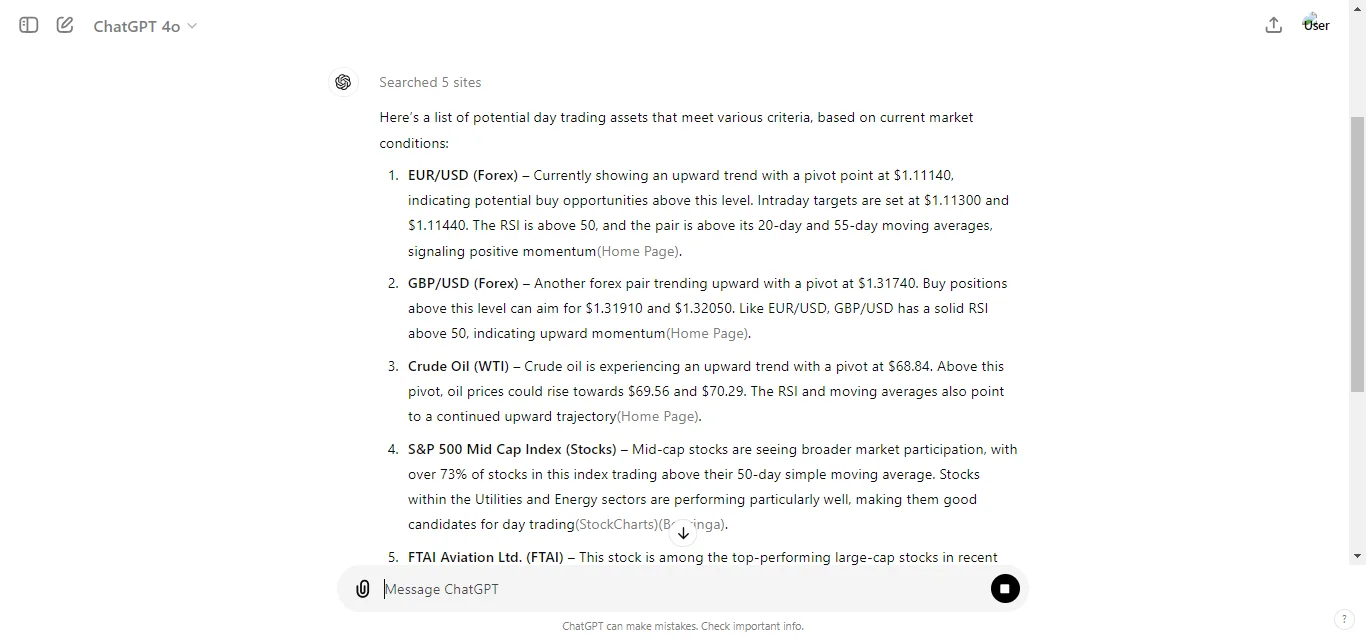
Act as a day trading assistant. Your task is to identify trading assets that meet the specified [criteria]. Utilize your expertise and available market analysis tools to scan, filter, and evaluate potential assets for trading. Once identified, create a comprehensive list with supporting data for each asset, indicating why it meets the criteria. Include relevant market sentiment signals and note any sector trends that may be influencing price action. Ensure that all information is up-to-date and relevant to current market conditions.
What this achieves: This prompt forces ChatGPT to act as a systematic screener rather than a generic commentator. Replace [criteria] with specifics like “RSI below 30, above 50-day moving average, S&P 500 sector” to get targeted output. Add “format results as a table” to make scanning faster.
ChatGPT Response:
2. Technical Analysis
ChatGPT Prompt:
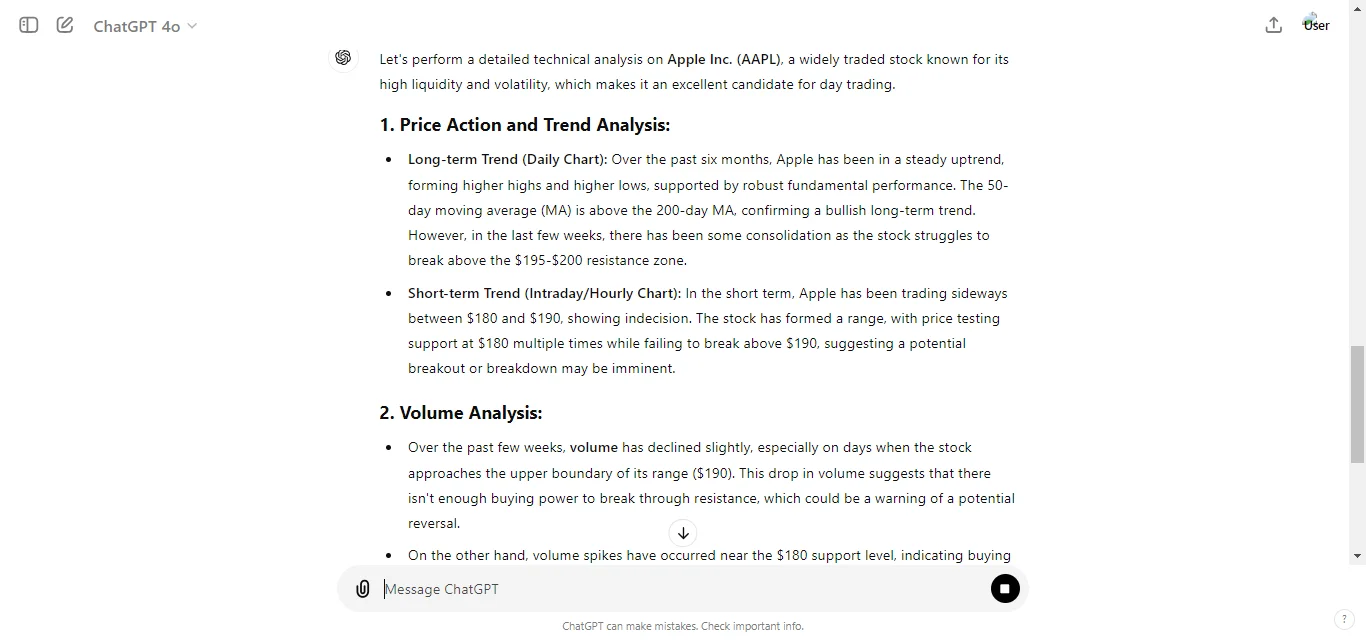
Act as an experienced day trader. Analyze the price and volume patterns of [TICKER] over the past [time period] to identify potential buying or selling opportunities. Use technical indicators including RSI, MACD, and moving averages. Identify key support and resistance levels, potential breakout or breakdown points, and any divergences between price action and volume. Provide a risk-reward assessment for each setup and flag any anomalies. Format your output as a structured report with a summary table at the end.
What this achieves: By naming specific indicators (RSI, MACD) and requesting a summary table, you get a structured technical analysis prompt output rather than a wall of text. Swap [TICKER] and [time period] for any asset and timeframe you are analyzing.
ChatGPT Response:
3. Fundamental Analysis & Stock Research
ChatGPT Prompt:
Act as a fundamental analyst. Research [TICKER] and provide a comprehensive overview covering: (1) business model and competitive moat, (2) key financial metrics including P/E ratio, revenue growth, operating margin, and free cash flow yield, (3) recent earnings reports and any guidance changes, (4) primary growth catalysts and risks over the next 12–24 months, (5) a brief sector analysis comparing [TICKER] to its two closest peers on valuation. Summarize your findings with a bull case, bear case, and fair value range.
What this achieves: This prompt structures a full fundamental analysis framework in a single request. It is especially useful for value and growth investors who need a quick company brief before a deeper dive. Replace [TICKER] with any publicly traded stock.
4. Trade Execution
ChatGPT Prompt:
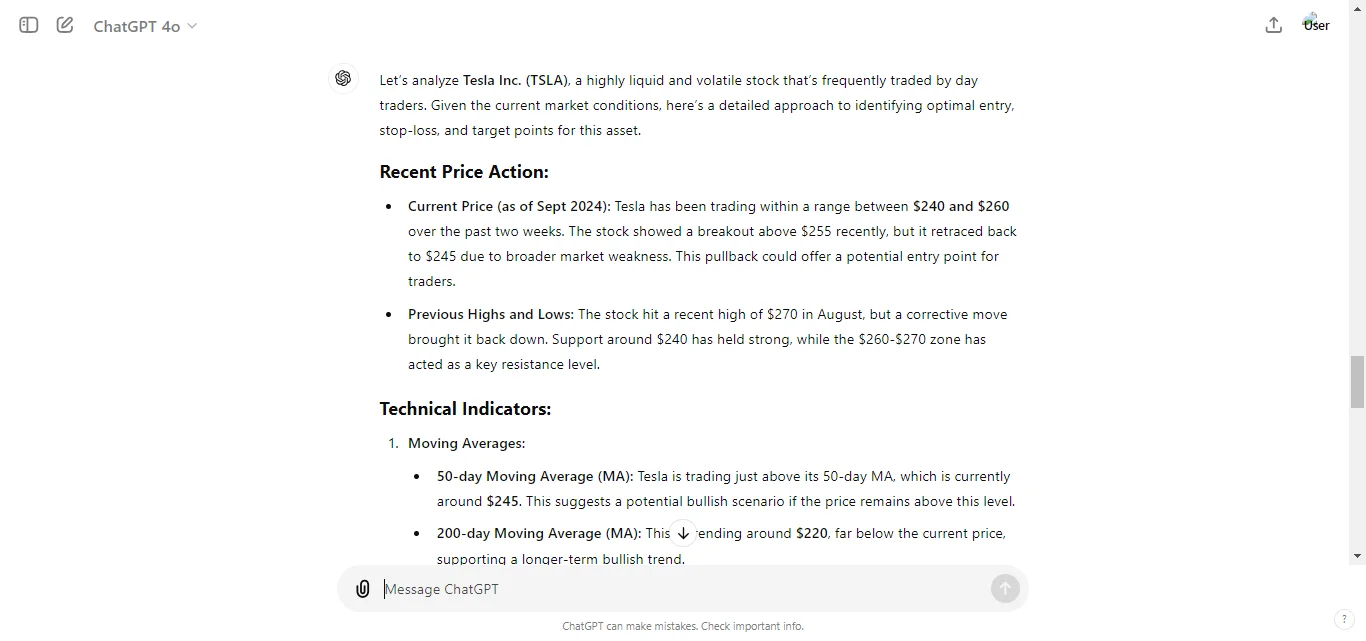
Act as an experienced day trader. Based on a comprehensive analysis of current market conditions, historical data, and emerging trends for [TICKER], identify optimal entry points, a stop-loss target, and a profit target. Specify the risk-reward ratio for the setup. Begin by reviewing recent price action, key technical indicators, and any relevant news that might influence the asset’s direction. Present your recommendation as a structured trade plan with clear entry, stop-loss, and exit levels.
What this achieves: Adding an explicit request for the risk-reward ratio keeps trade execution prompts grounded in risk management rather than pure speculation. Customize with a specific strategy constraint, e.g., “assume a swing trade holding period of 3–10 days.”
ChatGPT Response:
5. Trade Journaling
ChatGPT Prompt:
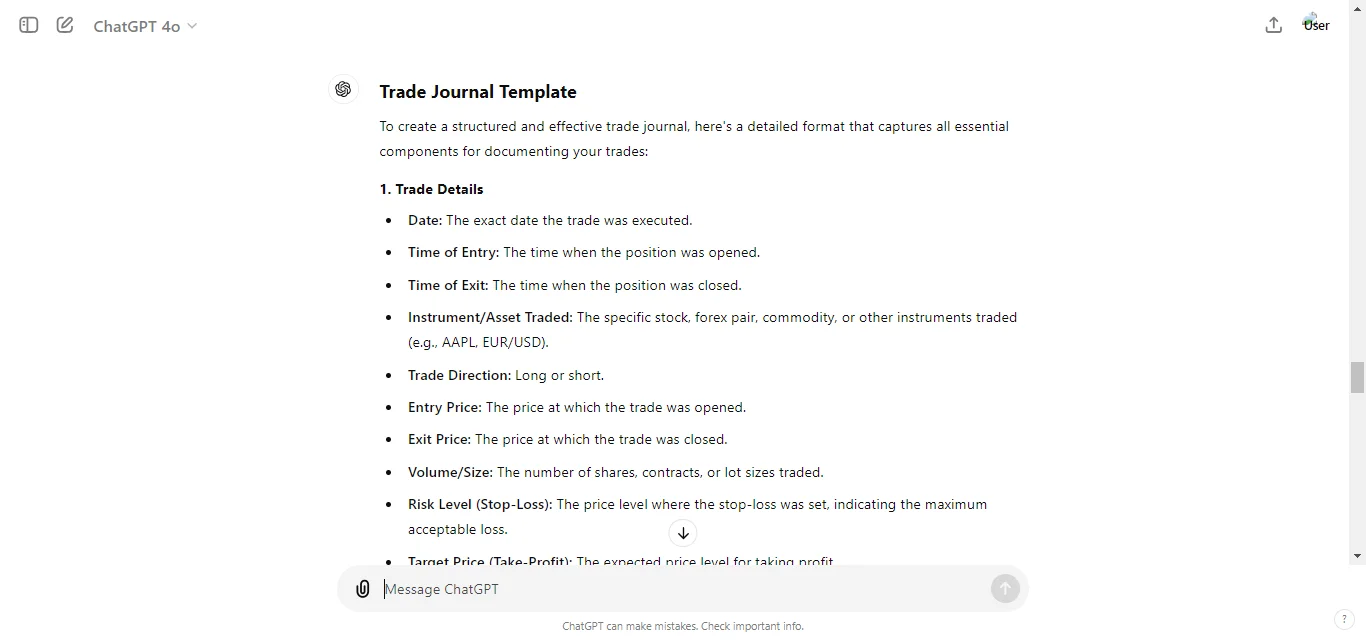
Act as an experienced day trader and help me build a structured trading journal. Design a format that captures: date and time of entry and exit, trade direction (long or short), instrument traded, entry and exit prices, position size, initial risk and target levels, the strategic rationale, actual profit or loss, and notes on execution quality. Suggest which metrics to track weekly — including win rate, risk-reward ratio, average profit vs. average loss per trade, maximum drawdown, and overall ROI — and explain how to review past trades to identify recurring mistakes without post-trade rationalization bias.
What this achieves: A trading journal prompt built around specific metrics (win rate, drawdown, ROI) keeps your review quantitative. Use this output as a template to build a spreadsheet or Notion database for ongoing documentation.
ChatGPT Response:
6. Performance Review
ChatGPT Prompt:
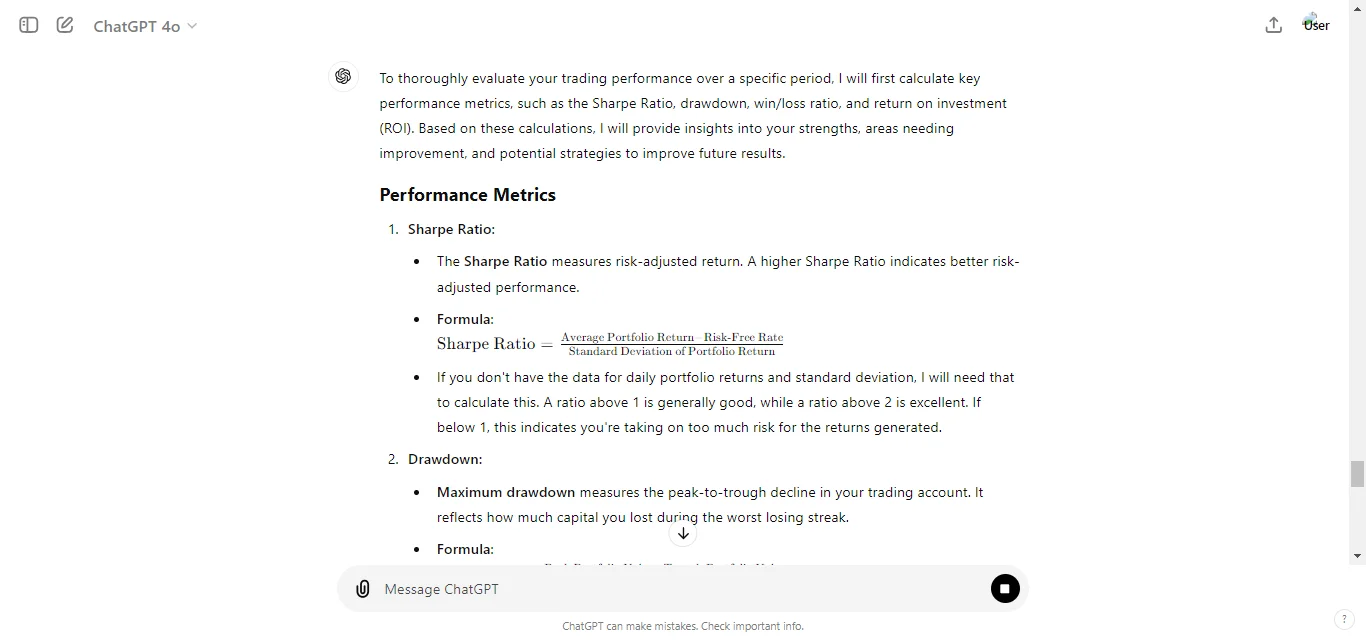
Act as an experienced trading coach. Review and evaluate my trading performance over [time period] using the following data: [paste your trade log or summary]. Calculate and interpret key performance metrics including Sharpe ratio, maximum drawdown, win/loss ratio, profit factor, and return on investment. Identify any discernible patterns or behavioral habits — positive or negative — affecting my outcomes. Provide three actionable adjustments I should make to my trading strategy or process based on these results.
What this achieves: Pasting your actual trade log data (even a simplified summary) gives ChatGPT something concrete to work with. The explicit list of metrics — Sharpe ratio, profit factor, max drawdown — ensures the output is analytically rigorous rather than generic coaching advice.
ChatGPT Response:
7. Trading Psychology
ChatGPT Prompt:
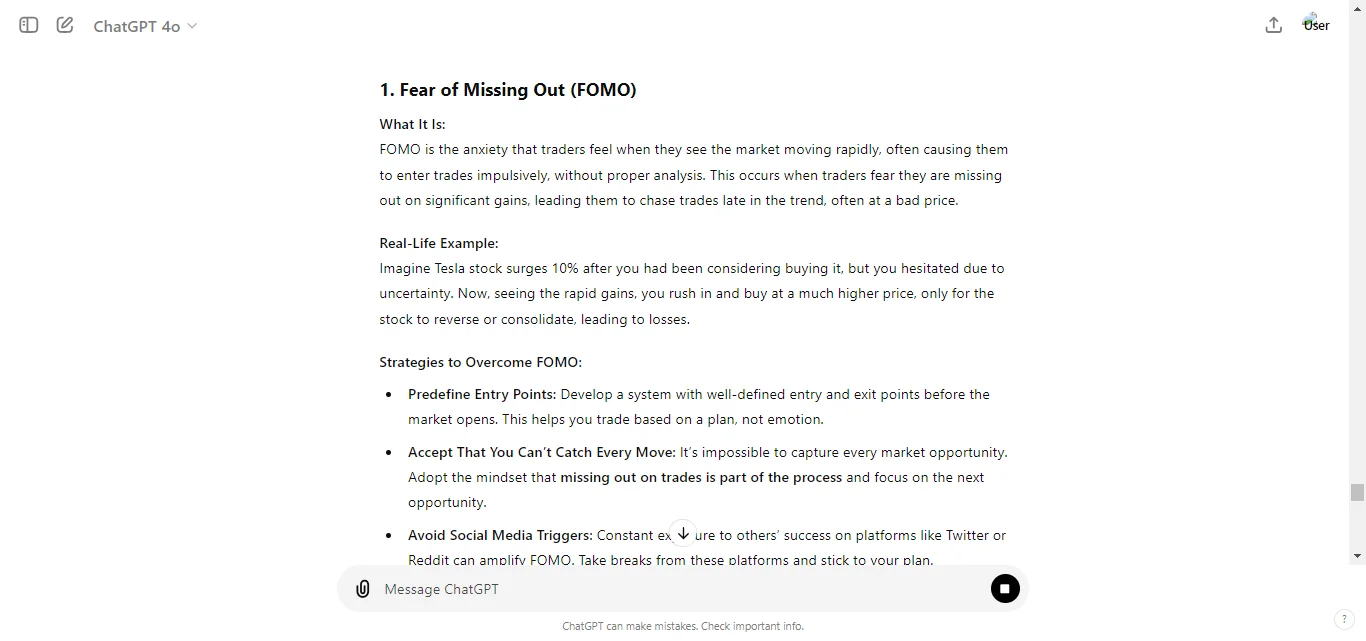
Act as a trading psychologist with deep knowledge of behavioral finance. Analyze the common emotional and cognitive challenges traders face — including FOMO, overconfidence, loss aversion, and analysis paralysis — and provide real-world trading scenarios that illustrate how each bias manifests in poor trading decisions. For each challenge, give me two to three actionable techniques to counteract the bias, drawn from both trading psychology research and practical experience. End with a short self-assessment checklist I can run through before placing any trade.
What this achieves: Adding the self-assessment checklist makes this a practical tool, not just a reading exercise. Use this prompt after a losing streak or before a high-stakes trading session to reset your mindset.
ChatGPT Response:
8. Backtesting
ChatGPT Prompt:
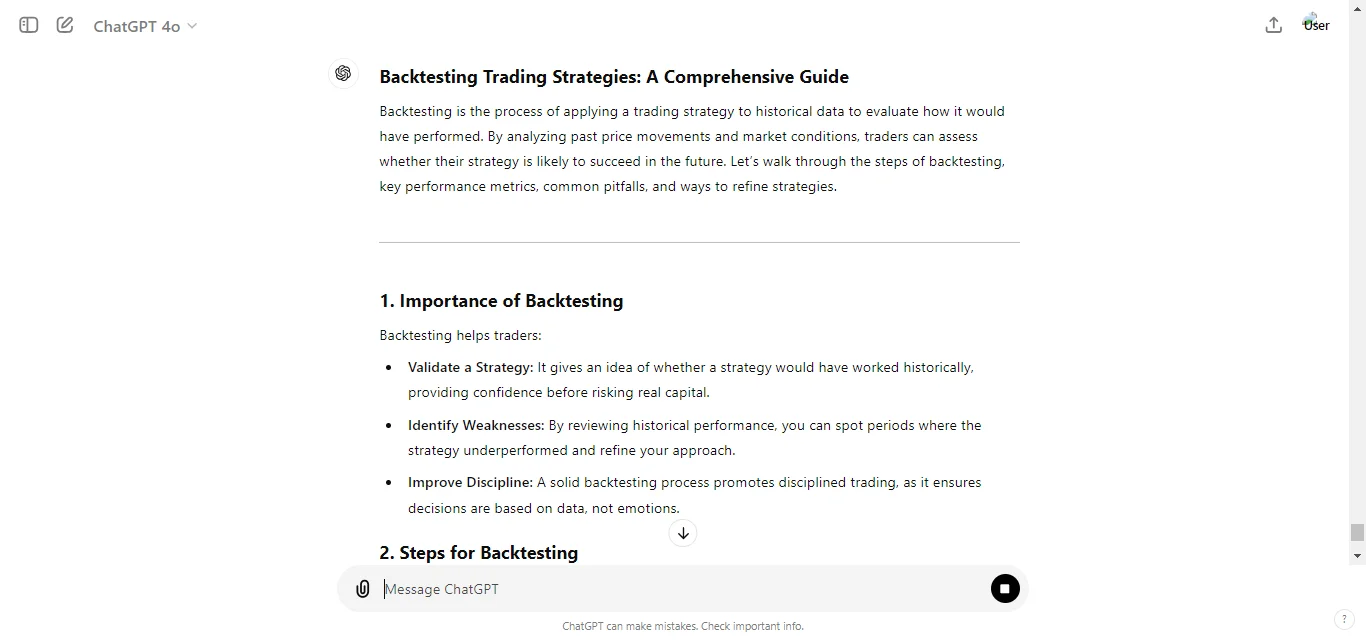
Act as an experienced quant trader proficient in backtesting. Guide me through backtesting the following trading strategy: [describe your strategy, e.g., “RSI mean reversion on daily SPY data”]. Cover how to select appropriate historical data, account for slippage and commissions, and avoid common pitfalls like overfitting and look-ahead bias. Help me interpret the key performance metrics — Sharpe ratio, maximum drawdown, profit factor, and win rate — and explain what each metric implies about risk and return. Based on hypothetical results, suggest how I might refine the strategy by adjusting entry criteria or diversifying the asset universe.
What this achieves: This prompt is designed for algorithmic trading and systematic traders who want to stress-test a strategy before going live. Replace the bracketed strategy description with your own rules. If you want ChatGPT to write backtesting code, add: “Generate a Python / PineScript / EasyLanguage implementation of this strategy.”
ChatGPT Response:
9. Strategy Coding (PineScript, Python & More)
ChatGPT Prompt:
Act as an expert algorithmic trading developer. Write a [PineScript / Python / EasyLanguage] script that implements the following trading strategy: [describe rules, e.g., “Buy when the 9-EMA crosses above the 21-EMA on the 15-minute chart; exit when RSI exceeds 70 or price crosses back below the 21-EMA. Use a 1% stop-loss from entry.”]. Include clear comments explaining each section of the code. After the code, note any assumptions made and flag potential issues with the implementation such as repainting indicators or look-ahead bias.
What this achieves: This prompt bridges trading strategy design and algorithmic trading implementation. It works for TradingView (PineScript), Python-based backtesting frameworks like Backtrader or Zipline, or TradeStation (EasyLanguage). Always review generated code before live deployment.
10. Pre-Market Preparation
ChatGPT Prompt:
Act as my pre-market trading analyst. Based on the following context — [paste overnight news headlines, futures levels, or economic calendar events] — give me a structured pre-market briefing covering: (1) key overnight developments likely to move markets today, (2) the two or three sectors or assets most likely to see unusual activity, (3) important support and resistance levels to watch on [INDEX or TICKER], and (4) a risk management reminder based on current market volatility conditions. Format the output as a daily briefing I can read in under five minutes.
What this achieves: This daily-briefing prompt turns raw news into an actionable pre-market plan. Because ChatGPT does not have live market data access, you need to paste the relevant context (news headlines, futures prices, scheduled earnings or macro events) directly into the prompt.
11. Continuous Learning
ChatGPT Prompt:
Act as a specialized trading educator in [topic — e.g., options trading, forex, swing trading, cryptocurrency]. Begin with the core concepts, then walk through two or three effective trading strategies with real-world examples, covering their pros and cons. Explain relevant risk management techniques including stop-loss placement and position sizing. Show how to interpret market data and charts for [topic] using both fundamental and technical analysis. Suggest reliable tools, platforms, and resources for further study, and finish with two or three practical exercises I can do this week to reinforce my learning.
What this achieves: Replace [topic] with any market or instrument you want to master. The practical exercises at the end push ChatGPT beyond theory into actionable next steps — a simple addition that significantly improves the output’s usefulness.
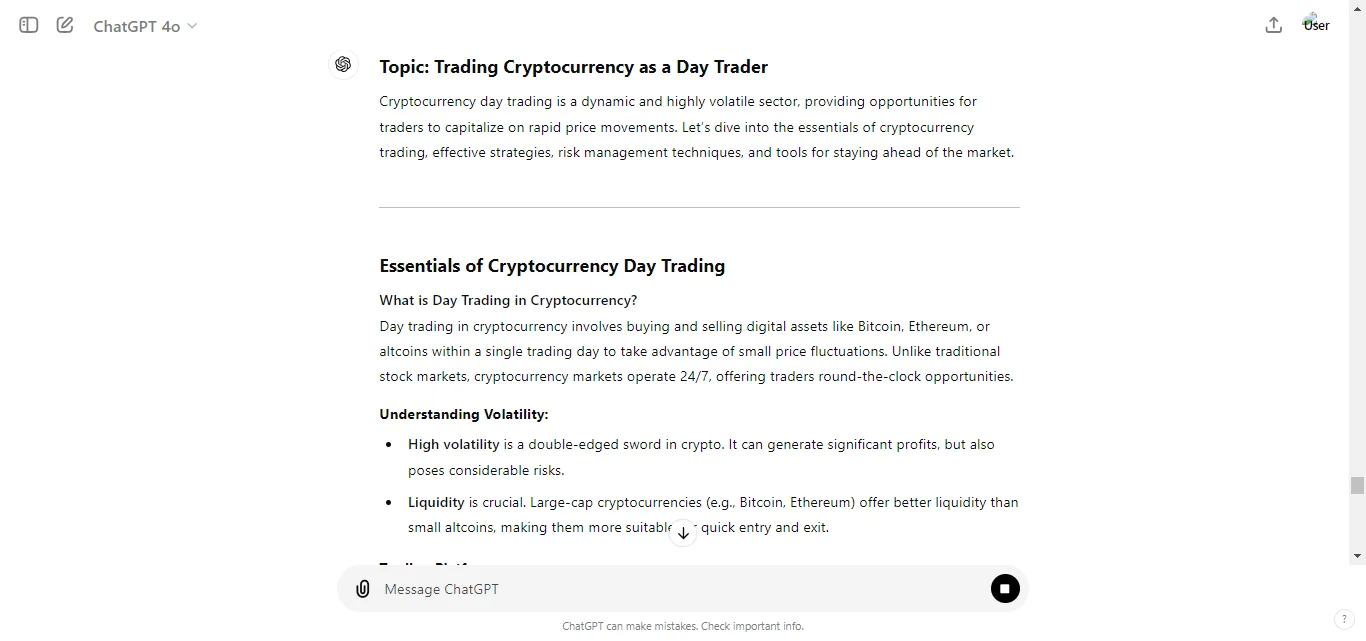
ChatGPT Response:
How to Customize Any Prompt
Every prompt above uses bracketed variables. Here is the quick customization guide:
- [TICKER] — replace with any stock (e.g., NVDA), ETF (e.g., SPY), forex pair (e.g., EUR/USD), or crypto (e.g., BTC/USD)
- [time period] — specify the lookback window: “last 30 days”, “Q1 2026”, “since the last earnings report”
- [strategy name] — name your system: “mean reversion on RSI”, “momentum breakout”, “covered call income strategy”
- [criteria] — define your screener rules: “large-cap tech stocks with a P/E below 20 and positive free cash flow”
Want hundreds more ready-to-use prompts across every trading use case? Browse the Complete AI Bundle — it includes prompt packs for finance, research, and strategy work.
Limitations of ChatGPT for Trading Decisions
ChatGPT is a large language model (LLM) built on natural language processing — not a financial data terminal. Before relying on any output, keep these limitations in mind:
- No real-time market data. ChatGPT does not have access to live prices, order books, or breaking news. Always cross-check with a live data source before acting on any analysis.
- Knowledge cutoff. The model’s training data has a cutoff date, which means recent earnings reports, macro events, or regulatory changes may not be reflected in its responses.
- Hallucination risk. Like all LLMs, ChatGPT can generate plausible-sounding but incorrect figures (e.g., wrong financial ratios, fabricated analyst targets). Verify any specific numbers independently.
- No personalized financial advice. ChatGPT is a research and brainstorming tool, not a licensed financial advisor. Use its outputs as a starting point for your own analysis, not as trading signals.
- Prompt quality matters. Poorly framed prompts produce generic responses. The prompt engineering framework in this guide exists for exactly this reason.
Used correctly — as a thinking partner, research accelerator, and journaling assistant — ChatGPT is a genuinely useful addition to a trader’s workflow. It won’t replace human judgment, but it can make that judgment faster and better-informed.
Wrapping Up: ChatGPT Prompts for Trading in 2026
With the right prompts, ChatGPT can cover the full trading workflow: scanning for opportunities, running technical and fundamental analysis, planning trade execution, journaling, reviewing performance, managing trading psychology, and even generating strategy code.
The key is specificity. Assign a role, provide context with real variables, set constraints, and request a structured output. That combination — not the AI itself — is what produces actionable results.
For more AI prompts built for serious workflows, explore the full ChatGPT prompts library or check out how these same principles apply to marketing AI prompts.